Showing posts sorted by date for query 1991 agreement. Sort by relevance Show all posts

Friday, January 27, 2023

UFT CONTRACT TEACH INS: CAN WE AT LEAST ALL HAVE THE SAME SET OF FACTS TO WORK FROM?

The UFT in 2023 is confusing if nothing else. I can't understand why an organization that usually encourages as little involvement from its members in confronting management is now suddenly promoting contract teach-ins for Monday, January 30. NYC Educator is not excited. Is he right? His conclusion:

A teach-in could be a great thing. But it's based on the premise that leadership is actually interested in what we think. I am not persuaded that's true. I therefore do not believe this teach-in, however genuine the sentiments of its creators may be, is done in good faith. I believe, and the evidence bears out, that leadership goes behind our back to make stupid deals that benefit no one in rank and file. 

I believe, therefore, that leadership needs to be replaced. And if by any chance I should get a voice in any teach-in, that will be my message to my union brothers and sisters.

As a 28-year dissident in this Union, I agree wholeheartedly with those sentiments. NYC Educator uses the recent retiree healthcare debacle to support his case that UFT leaders don't want to hear from us. President Michael Mulgrew, as one of the two main voices in the Municipal Labor Committee (Umbrella group of City Unions where the UFT has an outsized role because of weighted voting), tried to force retirees to accept a privatized Medicare Advantage Plan (Mulgrewcare) instead of public Medicare combined with a GHI Medigap supplemental plan. Mulgrew attempted, and may still be attempting, to force retirees into Mulgrewcare or stick them with copays or premiums but he has been stopped in court and by the City Council. We need to be skeptical about what the UFT is planning as active and non-Medicare-eligible retirees' healthcare is being negotiated behind closed doors by the MLC and City. In that atmosphere, we have  Monday's Teach-ins at the schools.

If you want to teach something at the UFT Teach-in in your school, how about an honest discussion? Share with the teachers and other UFTers how we need to go in with our eyes wide open. If Michael Mulgrew says again there are no givebacks, be skeptical. He said that in 2014 and 2018 but we know there were major healthcare givebacks, some that Mulgrew is still paying off now.

Honesty and openness are not usually strong traits at the UFT. When the UFT put out its slides and they said healthcare isn't a subject of UFT negotiations, I scratched my head and said, WTF?

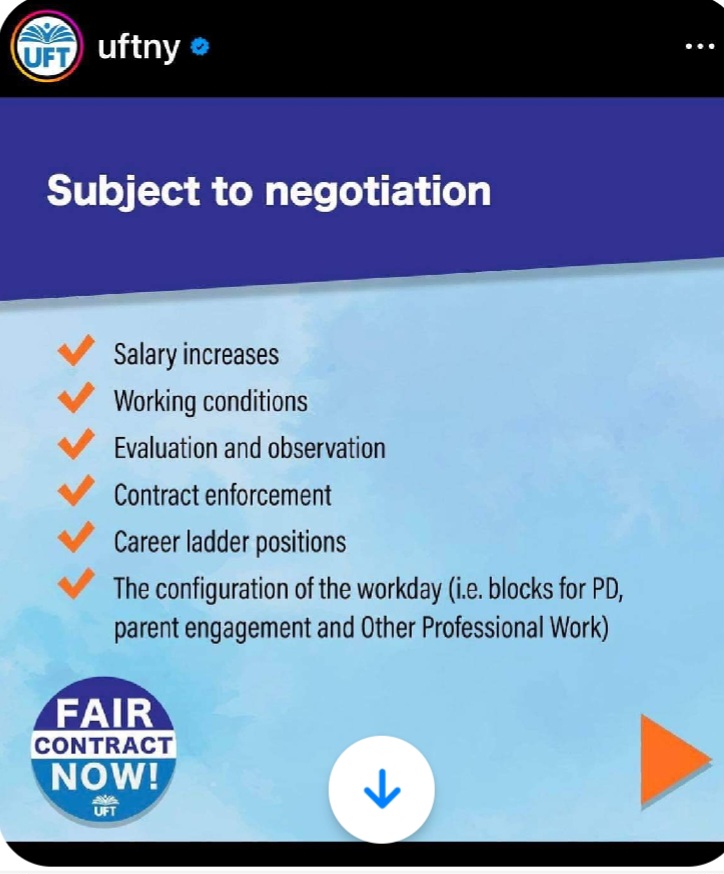
Here is a look at the UFT's two slides on what is on the table in contract negotiations and what is not:


We will now take them one at a time. For reference, here is the Contract.

  • Salary increases are negotiable but any raise is subject to pattern bargaining. When one City municipal union settles a contract for a round of collective bargaining, it sets a pattern and all of the other unions then follow that pattern and receive basically the same wage increase. DC 37 is negotiating with the City as of this writing as is the UFT. DC 37's last contract expired in 2021 and is long overdue. They set the last pattern in 2018 of around a little over 2% per year that the UFT and every other union pretty much adhered to. The UFT set the previous pattern of 10% total over 7 years in the 2014 round. That Agreement was extended twice but that is a whole different posting. You have to go back to 2008 when DC 37 set a 4%+4% pattern to find a decent one that today still wouldn't come close to keeping up with inflation. Do you think maybe we should talk about some other union like the PBA going first this time to set the pattern? NYPD officers start at $42,500. They never settled their last round of bargaining. City police make less than cops in surrounding areas and they want to catch up. Another idea you probably won't see in UFT literature would be to bargain financial terms as a coalition of City unions since we all get the same increases basically anyway. Should we push for cost of living adjustments like Social Security gives (5.9% 2022, 8.7% 2023; UFT's last increase was in 2021). Members should be openly talking about these salary issues. 

  • Working conditions are negotiable. The UFT made numerous gains in its first 40 years (class size limits, duty-free lunch periods, prep periods, etc.) but has been on the defensive mostly since mayoral control in 2002. In 2005, the UFT made major concessions. The Union gave away the right to grieve inaccurate/unfair letters in the file in 2005 and the right to have a separate grievance at the superintendent's level if a grievance was not resolved at the principal's level. We also surrendered the right to preferred placement if a school was closed or redesigned, the right to a position if excessed, and the right to have a real professional assignment where the Chapter Committee had to agree on a professional menu to pick from. We can negotiate here and should.

  • Teacher evaluation and observations are in the Contract but they are subject to state law which governs teacher evaluation. We can negotiate within the state guidelines.

  • Contract enforcement is subject to negotiation for sure as we could get a  better grievance process. The UFT won changes to expedite the grievance process in some instances in 2018 but it was a small gain. It is up to the UFT, not an individual grievant, whether a grievance proceeds to the Chancellor's level or an arbitrator. It should be at least up to a grievant to challenge a principal's judgment somewhere beyond the school. Furthermore, there are some provisions of the Contract the UFT does not bother to enforce. For example, it was agreed to go to a biweekly payroll as opposed to semi-monthly in 1996 in Article 3L:
L. Salary Payment 

1. The parties agree that a biweekly payroll gives employees a date certain for receipt of their pay. Therefore, the Board will convert the pedagogical payroll to a biweekly payroll from the existing semi-monthly payroll as soon as practicable. 

It's only been 27 years. What's the rush? The DOE and UFT need some time to work this out or take it out of the Contract. Our younger members weren't even born when this unenforced provision went into the Contract. We are still waiting. Another example is Article 3G1 (see below) which gives teachers the choice of free healthcare plans but the UFT through the Municipal Labor Committee gave that choice of free plans away in 2018 for first-year teachers. The Contract has to be enforced by members and by the UFT leadership to mean anything. Otherwise, it is not even worth the paper it isn't printed on anymore as the UFT no longer prints it out for members.

  • Career Ladder positions are negotiable. Honestly, are you really so worried about this that it gets a prominent place in what can be negotiated?

  • The configuration of the workday has been renegotiated on numerous occasions since 2002 when extended time was first negotiated into the Contract. It is up to the members to get rid of marathon Mondays (sometimes called teacher detention) if you want to. 


Now for the real head-scratchers:

  • Pension changes are subject to state law but they can still be a big part of contract negotiations between the UFT and the City. If the Union and City agree, both sides can go up to Albany and seek pension changes and it often ends up in the Contract. For example, 25 years of service-55-year-old retirement was put in the Contract in Article 4C:

 C. Pension Legislation

The parties have agreed to jointly support pension legislation as set forth in the letter attached as Appendix K.

For those who want some specifics on 25-55 pension in the Contract:

APPENDIX K PENSION LEGISLATION

October 17, 2007

Dear Ms. Weingarten: 

This letter will confirm certain mutual understandings and agreements of the parties. The parties agree to jointly support legislation to amend current pension provisions that will contain the following elements in order to implement an optional "25/55" retirement program for current employees in the Teachers Retirement System (TRS) and the below listed UFT-represented members in the Board of Education Retirement Systems (BERS) and to provide a revised retirement paradigm for newly-hired employees in TRS and newly-hired UFT-represented members in BERS listed below.

There is more in this letter but you get the idea. Early retirement incentives in 1991 and 1996 were agreed to in the Contract and then Albany approved them. On the downside, the reduction of the TDA fixed interest for UFTers from 8.25% to 7% was agreed to at the City-UFT level and then approved in Albany in 2009. Why aren't we demanding that the City go with us to Albany to end Tier VI and get 25-55 for all?

  • Tenure is also a state law but Mayor Michael Bloomberg's anti-teacher Chancellor Joel Klein made denying tenure a crusade in the late 2000s and hired hundreds of lawyers in part to help deny tenure. The UFT, had it chosen to, could have demanded contractual provisions to limit observations and otherwise limit principal power so tenure would be less onerous to achieve. 

  • Student Discipline. What is the UFT talking about that this is not negotiable?

Let's start by reading Article 9 and part of Appendix B of the Contract. Student discipline is there and subject to negotiation.


ARTICLE NINE PROCEDURES FOR HANDLING SPECIAL BEHAVIOR PROBLEMS 

The Board agrees that the procedures and policies concerning the problem of disruptive children, embodied in the Special Circular which is reproduced in Appendix B following this Agreement, will not be changed during the term of this Agreement, except that the Chancellor may modify the circular, provided that the Union finds such modification acceptable. The provisions of the circular shall be subject to the grievance procedure and to arbitration only for the purpose of determining whether there has been a failure to comply with the procedural steps prescribed in the circular.

Appendix B is on page 208:

APPENDIX B SPECIAL CIRCULAR 

1. A child who threatens or engages in physical violence to himself, his/her fellow students, or a teacher may be directed by the teacher to report immediately to the principal or other designated supervisor under such escort as is prescribed by the school. Such pupil shall not be returned to the classroom without consultation between the principal and the teacher. 

2. Pupils who so seriously disrupt the classroom work as to impede effective instruction may be reported by the teacher to the principal or other designated supervisor. Such report shall be in writing and shall contain substantiating data on the behavior of the child.

There's more if you want to read it.

Or how about Article 10A?

 A . Assistance in Assault Cases:

Or 10B:
B. School Safety 

The principal is charged with the responsibility of maintaining security, safety and discipline in the school.

How about 10C?
C. Citywide Security and Discipline Committee 

1. The Union and the Board shall establish a joint committee which shall meet on a regular basis to discuss and consider appropriate means of resolving safety and discipline issues. Other city agencies will be invited to participate when the Union and Board deem it appropriate.

  • DOE allocations of school funds are in the Contract too. This is another one where the slides are just patently wrong. Read Contractual Article 8C:
C. School Allocations 

Before the end of June and by the opening of school in September, to involve faculties and foster openness about the use of resources, the principal shall meet with the chapter leader and UFT chapter committee to discuss, explain and seek input on the use of the school allocations. As soon as they are available, copies of the school allocations will be provided to the chapter leader and UFT chapter committee. Any budgetary modifications regarding the use of the school allocations shall be discussed by the principal and chapter committee.

UFT chapters have contractual input into the use of school allocations.

  • Healthcare: Here again, the people who wrote these slides need to be schooled on the Contract they are supposed to be enforcing.
This is contractual Article 3G1:
G. Health Insurance and Welfare Fund Benefits 

1. Choice of Health Plans 

The Board agrees to arrange for, and make available to each day school teacher, a choice of health and hospital insurance coverage from among designated plans and the Board agrees to pay the full cost of such coverage.

Yes, the umbrella group of City unions called the Municipal Labor Committee can make changes to healthcare but they should conform to our Contract. Why again are we paying copays for HIP and GHI? Why is the City threatening premiums for GHI now for UFTers? This goes back to what I said before about the Contract not being adhered to and the UFT leadership not saying a bloody thing.

As for the MLC, they have over 100 unions but they have weighted voting as mentioned earlier. The UFT and DC 37, by far the biggest unions, make up over 60% of the MLC. If you think the UFT doesn't have a say on healthcare in contract negotiations, you would be wrong. 


Ultimately, the members of each bargaining unit (teachers, paras, secretaries, OTPT, etc.) have the final say in the Contract because you vote to approve it or reject it.

If you want to hear more of my insights (some would say meandering), join me as part of the panel on Zoom when Educators of NYC hosts a pep rally (I would call it a pre-teach-in) on Sunday evening at 7:00 p.m.


Wednesday, August 26, 2020

A DISSIDENT'S Q & A ON A POSSIBLE STRIKE

In the last week, I've been hearing from UFTers who are attending the virtual meetings that the UFT District Representatives, Borough Representatives and Officers are holding. The UFT should be putting out something logical, direct and fairly straightforward explaining how a strike or other kind of job action works that includes the possible advantages and discusses the risks openly. Instead, we get meetings with people who are used to selling subpar Contracts and lousy evaluation system agreements trying to sell the need for militancy and union solidarity. This is not a criticism as some of them have never done anything like this before and it isn't easy.

I understand some of you may have a little trouble believing some of the same people who told you the 2005 and 2014 Contracts were wonderful. Think about it, the leadership from the Unity Caucus is switching from a concessionary, bureaucratic, stance to a fighting one at lightning speed. Let me try to answer some of the questions and comments that I have seen so you can hear from a union dissident who from day 1 has believed that a militant union led by an informed and engaged membership is the best way to achieve our goals.

Question: Can I be fired if I strike?

Answer: NO! Read Section 210 of the Taylor Law for yourself, please. The penalty for striking is a fine of two days pay for each day out on strike, not termination. The Union can be fined heavily too and lose automatic dues checkoff. The UFT is risking a great deal more than individual members by talking strike.  

Question: When would we be fined?

Answer: No time soon in all likelihood. The Taylor Law in Section 210 2 (f) gives employees 20 days after being sent notice that they engaged in a strike a chance to appeal. Then there is a review process at the Public Employees Relations Board that can be appealed in state court. The last time I looked one was innocent until proven guilty in the USA. You don't even pay a parking ticket while you are appealing it. The appeal process could take a long time to sort out. Norm Scott,who was involved in the UFT strike in 1975, told me yesterday that it was years, not months, before he was fined. The UFT would have a very good case that there were mitigating circumstances here. One of the factors PERB and the courts have to weigh when penalizing a union is "the impact of the strike on the public health, safety, and welfare of the community..." This would not be an ordinary strike as our potential safety strike would be to benefit, not harm, the public health, safety, and welfare of the community. While it would drag out in court, we could certainly make dropping the case against us a condition for a UFT mayoral endorsement next year. Repeal of the anti-strike provisions of the Taylor Law that the United Nations International Labor Organization ruled is a human rights violation should be a major state legislative goal.  

Question: If we engage in a sickout, can we get around the fines?

Answer: It's possible since the DOE is almost encouraging us to stay out of buildings if we have something as common as a headache or a runny nose which are both symptoms of COVID-19. However, I don't want to get anyone's hopes up too high. The risks of Taylor Law penalties are real.

Question: Will we be terminated en masse if we strike?

Answer: NO! There was a risk of teachers being terminated in the 1959 Evening High School Teachers Strike and the 1960s UFT strikes when we were operating under a previous law that made termination the penalty for going on strike. Those teachers went on strike in spite of the risk. Today, the Taylor Law fines employees for going on strike. The penalty is not termination. This isn't 1981 with Ronald Reagan firing the Air Traffic Controllers for striking illegally against the federal government. If the DOE did try to use the disciplinary process to charge tens of thousands of strikers with misconduct, where would they find the lawyers and hearing officers? They could not.

Question: Can I lose my medical benefits if I strike?

Answer: Technically, yes but in reality the chances of it happening are slim to none. During the most recent GM strike, management threatened to take away healthcare benefits from the striking employees but they backed off. If we strike, we are violating our Contract (the DOE is violating it too by not giving us a safe work environment) so yes Mayor Bill de Blasio could try to take benefits away but our mayor fancies himself as a progressive champion of workers. He was a Bernie Sanders supporter. Do you honestly think de Blasio is going to go to the right of General Motors and take away health benefits during a strike for safety? Bernie would probably support us and join us. The Mayor would be siding with President Trump if he tries this. He would be to the right of GM management. In addition, I don't know if we will get 100% support for a strike but does the DOE even have the capability of taking off all of the strikers from health benefits but leaving the scabs on? I don't want to say it's impossible but it seems unrealistic.

Question: Will I lose my tenure if I strike?

Answer: NO. Once again, the Taylor Law fines public employees for striking. A previous version of the law may have taken tenure away for a year but I don't see it in the current law.

Question: Does the UFT need to take a strike authorization vote to strike?

Answer: Since a job action is not covered in the law, I don't think a membership vote can be compelled but I have never heard of a union going on strike without first getting the majority backing of the membership. The Delegate Assembly in my opinion would not be a sufficient mandate but I would still support the action if it were for a just cause. Back in 2002, the last time there was a UFT strike authorization, we voted in the schools. For those interested in precedent for a live vote of the UFT membership for an illegal strike, please read this account of the buildup to the successful 1962 Strike that was led by my UFT heroes Roger Parente and Sam Hochberg. Going on strike was opposed by Albert Shanker and then President Charles Cogen until after the majority voted to strike. The membership is ultimately in charge of a union, not the leadership. (The account of the 1962 strike I cited was inexplicably taken down from the UFT's website as was an earlier reference to the 1959 Evening High School Strike. All we have online are ICUFT blog excerpts.) 

Question: Will this be a long safety strike if we were to actually do it?

Answer: In all likelihood, though one never knows, the job action would not last more than a day or two. If the UFT was to strike or do a sickout or remote out, the City-DOE would almost certainly seek an injunction to stop it while we would be in virtual court seeking an injunction to close the school buildings because they are not safe. While we play dueling injunctions in court, the UFT's hand would be incredibly strong, I mean stronger than ever, if there were 100,000 UFTers who were not reporting to the school buildings. If 50,000 UFTers report to work in the buildings, we weaken our hand considerably, not only for right now but for the next generation. All of you who have been screaming that the UFT does nothing will be creating a self-fulfilling prophecy because when the UFT tries to do a safety action, you will have undermined that effort. Militancy will be set back another few years and we will be at the mercy of the City-DOE even more. As mentioned over and over, we have a contractual right to a safe work environment. 

The only other possible course of action is for the city to try to wait us out by refusing to negotiate. Comptroller Scott Stringer and Speaker of the City Council Corey Johnson have already showed up at the press conference announcing a possible job action and the UFT has plenty of other allies in the political and activist world who will support us. The progressive mayor will not ignore this; it would be an international story. There is no such thing as a guarantee but the odds are this would be a very short strike or that just us having a viable threat of it will force the City-DOE to settle. We will have plenty of community support. The UFT has cultivated that through the years. 

Question: If we engage in a job action, we will play right into de Blasio's hands and lose all public support. The city has no money. Won't this lead to layoffs?

Answer: Layoffs and the safety of the buildings are two different issues. 1/3 of the families have already chosen remote learning full-time for their children. That's a whole lot of people who think it won't be safe for their children in school buildings. I predict that number is only going to go higher and higher if the news keeps pouring out about how unsafe buildings are. If the UFT just waits for the City-DOE plans to fall apart without taking action, it could produce during the time we go into the unsafe buildings a spike in the virus that nobody wants. The UFT did not strongly advocate for members to leave or not enter unsafe buildings in March. It looks like they are trying not to make the same mistake twice.  If you don't believe buildings are unsafe, read this excerpt from Gothamist last week:

Speaking on WNYC's Brian Lehrer Show on Tuesday, Dr. Irwin Redlener warned that schools are "going to become hotbeds for the infections to take hold again and spread through the community."

"It's almost inevitable if we are in fact going to even hold some classes in real time in real classrooms," he added.

Earlier in the month, Redlener penned an op-ed in the Daily Beast in which he argued that schools should not reopen until point-of-care rapid testing and a vaccine are available.

"Until then, most school systems should hit the pause button rather than run that cruel experiment," he wrote.

A widely respected authority on pediatrics and public health who works at Columbia University, Redlener has informally advised the mayor throughout the pandemic. He now joins the chorus of critics led by the teachers' union that the reopening of New York City schools will put children and teachers at risk for contracting coronavirus.

On layoffs, with federal stimulus money in doubt, layoffs are on the table, safety strike or no safety strike. Those who are saying the mayor will be mad at us if we do a job action and we will require fewer teachers online so he will downsize the teaching staff have it all backwards. The Patrolmen's Benevolent Association is no friend of the mayor. They are one of his fiercest adversaries and they don't hide it. Guess who is being exempted from layoffs under the current layoff proposal: The NYPD apparently. When you fight, you may lose but you also may gain respect. 

Furthermore, the city needs borrowing authority from the State Legislature and the Governor in order to meet its needs unless the federal government bails us out. We have plenty of friends in the State Legislature. The big mistake Al Shanker made in 1975 was not getting a no-layoff agreement before we used our pension fund to buy all those city bonds. The UFT did not make the same mistake twice and got a very nice package in 1991 in exchange for loaning the city part of our raises. (Scroll down on that link to my speech that I never got to deliver.)  

Question: NYC's infection rate is very low and the City-DOE are doing all of these inspections to make sure buildings are safe. Shouldn't we rely on their expertise and go to work in schools?

Answer: I am not a scientist by any means but top scientists are urging that opening school buildings should be delayed as we stated earlier. Sending hundreds of thousands of students and close to 100,000 DOE employees back into the school buildings might spur on a second wave of COVID-19. Doctor Anthony Fauci said we would be engaging in an "experiment" if we open school buildings. No school system that I know of suffered the losses that NYC did in the spring. I am not willing to take the chance of risking lives. My own kids will be learning fully remotely in the fall. I don't trust anything the DOE says and neither should you. Watch this video if you want to see part of a DOE's toilet paper and yardstick school air inspection. In addition, this was in Chalkbeat NY concerning the inspections of schools:

With about two weeks left before school starts, Mayor Bill de Blasio announced Tuesday a last-minute effort to send teams of engineers from the School Construction Authority to conduct classroom-by-classroom inspections of ventilation systems.

Meanwhile, the education department had already tasked hundreds of educators — instructional leaders, achievement coaches, and others who work in the city’s borough offices — to begin doing walk-throughs of school buildings this week. The education department only announced the engineer inspections after Chalkbeat inquired about having educators who felt unqualified for the task doing detailed inspections. These educators will still make a determination about whether school buildings are safe to reopen. Many say that they haven’t been trained what to look for and that they are being asked to wave inspections through even if they find red flags.

“Under no circumstances should you complete a survey and indicate that the building is not ready to open without consulting the Director of Operations,” stated a memo obtained by Chalkbeat that had been sent from the director of operational support to education department staffers tasked with conducting walk-throughs.

Anyone who trusts the DOE inspections or much of anything the DOE says needs help that I can't provide. 

Question: UFT President Michael Mulgrew seems to go back and forth with his emails, Town Halls and press conferences between militancy and concessionary unionism so why should we trust what he says?

Answer: Michael Mulgrew is not the UFT. Yesterday, he seemed to be falling back on his natural anti-militant tendencies when he wrote: "We have a responsibility to try to reopen school buildings because the infection rate in New York City is so low. But if the mayor attempts to open a school building that is unsafe, we are prepared to go to court or take a job action." That was no call to action and didn't even acknowledge that the goal should be to get all of the schools to delay opening. However, at last week's presser he was singing a more militant tune. He can only go where the membership takes him. Mulgrew is feeling the heat from below. He needs to know the membership is close to 100% with him if he takes us in a more activist direction. Otherwise, as said earlier, we will set our cause back another decade or more. If the UFT doesn't get militant when member lives are possibly at stake, when will we?

In 2002, the UFT threatened a strike. The main issue was how to use the extended time being negotiated. It was not easy convincing the Jamaica staff to go on strike but in the end we pretty much got there. Randi Weingarten promised us voice and choice in the use of extended time. She put one of her biggest critics, me, on the UFT Strike Committee. I learned a great deal that spring from Staff Director Tom Pappas as he talked logistics and the trick of the strike he told us was not actually striking but being able to convince the City we were serious. One day that spring, I was travelling home from a relative's house in New Jersey. I remember it like it was yesterday. I turned on Newsradio 880 to hear the traffic and Chancellor Harold O Levy was being interviewed. The reporter asked him about a teacher strike that we were voting on. He answered in the most condescending way: "There's not going to be a strike." Everyone but me knew we didn't have the guts to do it. The result was management controlled extended time; the provision was so bad it was renegotiated four times and then the UFT finally surrendered on so much more with the 2005 Contract. We refused to battle like a union so we lost. That could repeat itself now.

I want to add here that I understand Mulgrew's reluctance to be strong and I get a little down myself when looking at some of the anti-job action comments here and on Facebook. My whole UFT life was spent fighting the activist fight in whichever way was possible. I was only ever successful because a huge majority, not everyone, in my chapter was with me. Peaceful struggle when it is called for is in my DNA. 

Mulgrew's career has been to play the political game. UFTers could have voted for me when I ran against him in 2010 but over 90% of you who voted, chose him. I was vindicated slightly in 2016 when a majority of the high school members who actually bothered to vote, chose me to be their Vice President but Vice Presidents are elected at large and the High School Division is but one of four in the UFT. That election did propel some independent thinkers to be on the UFT Executive Board. Mike Schirtzer is still there now. Show them support.  

In the end, Mulgrew will get as far as a united membership will take him. It's up to all of you more than him.  Understand your power and use it wisely. 

Sunday, May 18, 2014

FINAL MOA CONFIRMS: NO INTEREST ON OUR LOAN TO CITY; RETIREES MOVE TO HEAD OF PAYBACK LINE; CITY HAS FINANCIAL INCENTIVE TO GET RID OF US; HEALTHCARE STILL A MYSTERY

In bold below is much of the first two pages of the final Memorandum of Agreement between the UFT and the City/Department of Education that is finally online.  Everything else has been available already but I have several specific concerns after reading the finished document.

It is clear from the MOA that retirees and those who will retire in June are jumping to the head of the line in terms of getting their full 2009-11 pay immediately while active people have to wait up until 2020. This flies in the face of union solidarity.  All should be treated equally.

Active people staying beyond June have to settle for 2%, + a $1,000 bonus and an IOU from the city for 2009-2011. Our loan to the city will be paid back without interest in five installments between 2015 and 2020. On our salary scale, we are looking at four years of 0% increases from May 2009-May 2013.

Keeping this in mind, the new contract seems to provide the city with a financial incentive to get rid of as many of us as possible before we can retire to keep from having to pay off on those significant IOU's. Those who resign before the payout dates get nothing. In the past, we didn't worry because of fairly strong tenure laws but the loan terms and the contract's weaker due process provisions (burden of proof is now on teachers after two ineffective ratings and Absent Teacher Reserves face one day dismissal hearings) are worrisome. 

For newer people, there is also an incentive for the city to throw probationary UFT members overboard so as not to have to pay off the IOU's.  You think it's tough getting tenure now?  Just wait.  Their replacements get a pittance or nothing depending on when they are hired.

Unfortunately, some of those Bloomberg era Leadership Academy principals will know what to do to save the city some real cash.

Also, the healthcare agreement asks us to trust the UFT to make unspecified savings in healthcare costs or we could end up with a new healthcare agreement as part of this contract that costs us more money and/or cuts benefits.

Some of the actual language of the MOA in bold:

B. 2009-2011 Round – Salaries and rates of pay as customarily done:

 i. 5/1/15: 2%

 ii. 5/1/16: 2%

 iii. 5/1/17: 2%

iv. 5/1/18: 2%

 
C. Structured Retiree Claims Settlement Fund

Upon ratification, the City shall establish a Structured Retiree Claims Settlement Fund in the total amount of $180 million to settle all claims by retirees who have retired between Novem- ber 1, 2009 through June 30, 2014 concerning wage increases arising out of the 2009-2011 round of bargaining. The Fund will be distributed based upon an agreed upon formula.

 
D. Retirements after 6/30/14 shall receive lump sum payments based on the same schedule as actives as set forth below in paragraph E.

 
E. Lump Sum Payments stemming from the 2009- 2011 Round and schedule for actives for those continuously employed as of the day of payout.

i. 10/1/15 – 12.5%

ii. 10/1/17 – 12.5%

iii. 10/1/18 – 25%

iv. 10/1/19 – 25%

v. 10/1/20 – 25%


F. General Wage Increases Salaries and rates of pay as customarily done:

i. 5/1/13: 1%

ii. 5/1/14: 1%

iii. 5/1/15: 1%

iv. 5/1/16: 1.5%

v. 5/1/17: 2.5%
 
vi. 5/1/18: 3%

Here are some possible questions to ask your friendly Union salesperson in the next two days before most people vote. I Highly doubt most of these questions will make it to Michael Mulgrew's video webcast on Monday, particularly question 5.

1-Since there is no payout of money from 2009-11 for people who resign or are terminated, doesn't that give the city a financial incentive to terminate or force as many of us as they can to resign before the full payouts are made?
  • Won't this financial incentive to not keep people from 2018-2020, when the bulk of the 2009-11 payments are made, make getting tenure even harder than it is now?
  • Isn't there also a financial incentive for the city to use the weakened due process provisions (one day hearings based on undefined "problematic behavior) to terminate as many Absent Teacher Reserves as possible before we can retire so as not to have to pay us the 2009-11 money or pay us full pensions? 

2-People who retired in the last four years get full back pay now for work done from between November 2009 and the time they retired.
  • People retiring in June 2014 get full back pay (10%) and a thousand dollar bonus (pensionable).
  • Those who can't retire now get 2%, a thousand dollars and an IOU from the city.  (If one can't retire in the next three years, the bonus won't matter when counting final average salary for pension.)

  • Why are June 2014 retirees and those who have retired since November 1, 2009 moving to the head of the line in terms of getting their full arrears from 2009-2011 now? 

    3-How is the payout schedule equitable for active members compared to retirees?

    4-Didn't the city just move $725 million to the current year's budget to pay for this settlement while the cost to pay off the retirees is only $181 million according to the MOA?  Why aren't all of us getting more than 2% and a $1,000 bonus now? (Even Bloomberg left some money in the labor reserve fund.)

    5-Since, retirees are the most loyal constituency for the Unity Caucus (Michael' Mulgrew's political party), could that be why retirees or those leaving in June jump to the head of the payout line?

    6-Why is there no interest on our loan to the city?  (In 1976 and 1991 when UFT members lent the city money, they paid us back with interest.)

    7-What happens if someone takes a Leave of Absence during this contract?  In section 3E it says, "Lump Sum Payments (notice they don't call it retroactive pay) for actives for those continuously employed as of the day of payout."  I hope someone who takes a childcare leave, for example, still receives the full payouts. This one should be easily answered.

    8-Look closely at 3D where it states: "Retirements after 6/30/14 shall receive lump sum payments based on the same schedule as actives as set forth below in paragraph E." Does that mean these retirees would get everything they are owed or only the payments as of the date they retire?  For example if someone retires in 2015, do they only get a lump sum payment for 2015 or are they paid for the 2017, 2018, 2019 and 2020 payments for their past work?  UFT has assured us, both orally and in writing, we would get the full payments for 2009-2011 if we retire after this June but why doesn't it explicitly say that in the MOA?

    9-Why are other unions like the SBA and TWU Local 100 criticizing this deal as subpar?


    H. Healthcare Savings
     
    a.  The UFT and the City/DOE agree the UFT will exercise its best efforts to have the MLC agree to the following:

     i. for fiscal year 2015 (July 1, 2014-June 30, 2015), there shall be $400 million in savings on a city- wide basis in health care costs in the NYC health care program.

    ii.  for fiscal year 2016 (July 1, 2015-June 30, 2016), there shall be $700 million in savings on a citywide basis in health care costs in the NYC health care program.

    iii.  for fiscal year 2017 (July 1, 2016-June 30, 2017), there shall be $1 billion in savings on a citywide basis in health care costs in the NYC health care program.

    iv.  for fiscal year 2018 (July 1, 2017-June 30, 2018), there shall be $1.3 billion in savings on a citywide basis in health care costs in the NYC health care program.

    v.  for every fiscal year thereafter, the savings on a citywide basis in health care costs shall continue on a recurring basis.

    vi. The parties agree that the above savings to be achieved on a Citywide basis are a material term of this agreement.

    vii.  In the event the MLC does not agree to the above citywide targets, the arbitrator shall determine the UFT’s proportional share of the savings tar get and, absent an agreement by these parties, shall implement the process for the satisfaction of these savings targets.

    viii.  Stabilization Fund: (1) Effective July 1, 2014, the Stabilization Fund shall convey $1 billion to the City of New York to be used in support of the pro rata funding of this agreement.
    (2) Commencing on July 1, 2014, $200 million from the Stabilization Fund shall be made available per year to pay for ongoing programs (such as $65 welfare fund contribution, PICA payments, budget relief). In the event the MLC does not agree to provide the funds specified in this paragraph, the arbitrator shall determine the UFT’s proportional share of the Stabilization Fund monies required to be paid under this paragraph.

     
     I. Dispute resolution regarding paragraph H.

    a.  In the event of any dispute, the parties shall meet and confer in an attempt to resolve the dispute. If the par- ties cannot resolve the dispute, such dispute shall be referred to Arbitrator Martin F. Scheinman for resolution.

    b.  Such dispute shall be resolved within 90 days.

    c.  The arbitrator shall have the authority to impose interim relief that is consistent with the parties’ intent.

    d.  The arbitrator shall have the authority to meet with the parties at such times as the arbitrator determines is appropriate to enforce the terms of this agreement.

    e.  The parties shall meet and confer to select and retain an impartial health care actuary. If the parties are unable to agree, the arbitrator shall select the impar- tial health care actuary to be retained by the parties.

    f.  The parties shall share the costs for the arbitrator and the actuary the arbitrator selects.


    10-What are the unspecified healthcare savings we have to come up with?

    11-What are the consequences if we don't meet the savings targets?

    12-Will the savings mean cuts in benefits at some point?

    13-Aren't we leaving too much up in the air here?

    14-Why won't the leadership allow open debate on the contract? 

    15-Why are you telling Chapter Leaders to push the contract when they are running the vote?  In the current weekly Chapter Leader Update there is a section called "The chapter leader's role in the contract ratification process."  Here are the last two sentences: "As a chapter leader, you represent the voice of the UFT in schools. Please share the message with your members that this contract is a victory not only for UFT members but also for the students and the communities we serve." Shouldn't Chapter Leaders be neutral concerning the vote?  I will do my best not to push a no vote when people are voting. It's their decision.

    Thursday, May 08, 2014

    MULGREW MANGLES DEMOCRACY BEYOND RECOGNITION AT DA AS CONTRACT IS SENT TO MEMBERSHIP

    It was a very sad day indeed in the history of democracy at the May Delegate Assembly.  The meeting was moved to the NY Hilton.  I am going to dispense with my usual lengthy summary of what President Mulgrew said because you've already seen most of it in the UFT propaganda literature or you will hear it when union representatives come to your schools.

    Mulgrew made the case for the contract for over an hour and then doubled the question period to half an hour to speak some more.  He finally allowed for debate on the contract after 6:00 pm when there is an automatic adjournment at 6:15 p.m. His basic argument is that the city has no money for raises because former Mayor Bloomberg depleted the labor reserve. The one sided discussion was worse than even the usual DA mangling of democracy.  It was a complete sham.

    After Mulgrew finally finished talking, one Unity person (majority caucus of the UFT which does not allow dissent) spoke in favor of sending the contract to the membership for ratification and then Mulgrew pointed to a second Unity member and that is when I sprung forward and called for a point of order.  As everyone who regularly reads this blog knows, debate is supposed to alternate between speakers for and against every topic according to Robert's Rules.  Since there was a speaker for the contract, there should be one against.  The Unity speaker was willing to yield the floor so Mulgrew gave it to me.

    I had a thorough speech ready (see below) where I was about to go point for point to refute much of what Mulgrew said.  I started right out on the economics. 

    "Up until two months ago at the DA, Mulgrew was telling us that the city has money but they always say they are broke.  I keep reading in the papers that the city surplus is growing."

    (Mulgrew in February:
    “We look at the city’s fiscal numbers all the time; it is clear to us that there is money out there. We need our teachers to be paid at least at the level of the school districts around us, which we are not.”)

    I continued: "The city is not in bad shape financially so why are we settling for so little.  If we take out the 4% + 4% for the first two years that just equals the last pattern (and we won't see it until between 2015 and 2020), the pattern we set for the rest of municipal labor is 10% total over 7 years."  That is the worst pattern in municipal labor history (at least as long as I have been around)."  At this point, Mulgrew stopped me and said I was wrong.  I responded that according to Robert's Rules when I have the floor, he has no right to interrupt me. I also told him that I have an interpretation of what's in the agreement and so does he and that doesn't make me wrong.

    Someone then called a point of order and said that during the question period we agreed that people would only get 30 seconds to ask a question so I was only entitled to the floor for 30 seconds and my time was up.  Mulgrew said I could make one more point and I responded by telling him that the 30 second rule was for the question period.  I also stated that I sat and listened to him politely for an hour motivating the contract and now it was my turn.  He claimed that was my one point and time was up.  I then proceeded to say that I wished I was being recorded (earlier he said UFT policy is no recording) because the entire membership should be permitted to see how he treats people who are dissidents.  There was fairly loud applause as I walked away. 

    Maybe I should have stayed and further held my ground but I felt I blew away his no money argument and other people could handle some of the other issues as well or better than I could.

    Unfortunately, they never had the chance.  The opposition's next speaker took his 30 seconds to point out how Mulgrew was wrong on his 30 second rule as it pertained to the question period.  We had one other Delegate who had the chance to speak.

    Mulgrew then stopped the debate at exactly 6:15 p.m. and called for the vote.  The overwhelming Unity majority obeyed their caucus obligation and supported the contract.

    Time allotted for contract discussion:
    • Pro contract side talked for well over an hour. 

    • The opposition was given about 3 minutes of which half of the time was spent trying to keep the floor and tell the president he was out of order.  Would you call that a fair debate?

    I have written out the points I wanted to make and will instead make them here.  Below that is a statement on health care.  We don't have to make up anything about the contract.  It is bad enough to fall on its own.

    Opposition to Contract 2014
    This Contract is based on deferred payments. President Michael Mulgrew told us that we have had wages deferred before.  He mentioned a wage deferral from 1991(in an email).  Let’s go look at that deferral and compare it to the current proposal.  
     
    Back in 1990 we had a union friendly mayor who gave us a one year pattern bargaining busting raise of 5.5% however the economy was about to go into recession and the city soon thereafter found itself in a cash crisis.  The city threatened to lay off thousands of teachers including me.  To bail the city out, the UFT agreed to loan part of our raise to the city.  In order for the city to get us to accept loaning them our money, they had to sweeten the deal.
     
    In return for loaning the city much of our raise, we gained:
    * An ironclad no layoff agreement
    * The February midwinter recess (we used to work that week)
    * The ability to retire directly after a sabbatical
    * A very generous retirement incentive that gave people up to three years pension credit allowing those with thirty years in the system to leave as early as 52 years old 
    * 9% interest on the loan when we got the money back in 1996.

    Thanks to the majority of the members of this union who agreed that solidarity with our most vulnerable members like me was important, my job and the jobs of thousands of other teachers were saved.

    Let’s fast forward to today where again we have a union friendly mayor but now we have been beaten down by corporate school reform for a long time.  The city again wants us to defer money. This time it is the 4% + 4% raises other unions got that we are owed since 2009. In addition we are setting the worst pattern in municipal union history that other city unions will have to swallow of 10% over 7 years. I look at the city budget and I don’t see a crisis.  I see surpluses but let’s accept the premise that the money is tight.

    If unions accept less money, then what are the sweeteners in this deal for us?

    * Changing the use of the 37.5 minutes.  By my count, the extended time provision has been reconfigured 6 times since it went into the contract in 2002.  What makes anyone think this change of two days of professional development and parent outreach will be better than the tutoring or other uses of extended time? It is not a gain. 
    * Merit pay or career ladder.  The ambassador teacher, model and master teachers just creates different classes of teachers.  It flies in the face of union solidarity.  We are one union. Funny how there is money for merit pay and the hard to staff school differential but not for our raises. As for the argument that it isn't really merit pay, paying select teachers more than their peers is merit pay. Don't they need to be highly effective or effective which means it will be based in large part on student test scores? If it walks like a duck and quacks like a duck, it usually is a duck. 
    * We get a curriculum.  Not exactly a gain. We also now have to write unit plans.
    * Up to 200 schools will be run like charter schools with short contracts.  I thought the UFT started a charter school to show how schools can succeed if they follow the contract. Now we want to run schools like charter schools without contracts.  
    * Slightly altering Danielson but still basing our ratings in part on student test scores.  No gain there as now the whole lousy evaluation system is part of the contract.
    * No interest on the deferred money unlike in 1991 when we got 9%.
    * An insulting severance package for ATRs.
    * Weaker tenure for ATRs.  Two documented occurrences of "problematic behavior" and we are in a 3020a hearing.  This provision divides the union into two types of membership; regular and ATR.  It’s antithetical to union  solidarity. We are one union; we should have one tenure system for all of us. If this new system for ATRs is so good like the President says, why not give it to everyone?  How can one argue this isn't worse than a major giveback? 

    If we are deferring our money, where are the gains?  Where are the sweeteners?  All I see is the acceptance of the basic tenets of Bloombergism but tweaking them a bit. Those are not gains.

    In 1990, The DA rejected a loan to the city and sent the Negotiating Committee back to the table to get a better offer.  They did.  In 1995 against a tough mayor, the membership rejected a contract and got a better offer a few months later that had a retirement incentive, a 25 year longevity reduced to 22 and a 5% reduction in new teacher pay was eliminated.  Where are our sweeteners now?
     
    Yes these are tough times for unions and educators but this union has a choice: we can accept this contract which basically leaves the Bloomberg anti-teacher system in place or we can follow the lead of the teachers in Portland, Oregon and St Paul, Minnesota who have fought back and gotten better deals for their schools including lower class sizes.  The UFT did better in 1991 after this DA rejected an original loan proposal and we did better in 1995 when the membership voted down a contract. We can do better now. 

    VOTE NO!


    The contract is bad enough on its own.  We don't need to say anything that isn't true.  This is what UFT Welfare Fund Director Arthur Pepper said on healthcare.

    Healthcare
    Arthur Pepper reported that the UFT found the necessary savings the city wanted so there will be no effect on members.  We will have the same access to doctors, hospitals and the drug plan won't change.  There will be no premium for members.


    Sadly Leroy Barr's mom passed away so our thoughts and prayers go out to Leroy and his family.


    Tuesday, January 20, 2009

    TEACHING FELLOWS CASE SHOWS WE LACK A NO-LAYOFF AGREEMENT

    The UFT has been telling us since 2005 that the Absent Teacher Reserve clause, that replaced the seniority and SBO transfer plans, guarantees excessed teachers the right to a full time Absent Teacher Reserve position and is therefore a de-facto no layoff agreement (unless the city declares a financial emergency). This turns out to be another myth.


    ICE grows weary of being proven right over and over again about our warnings concerning the giveback laden 2005 Contract. The latest example is the teaching fellows (RTRs) who were forced to sign a pre-employment letter saying they would obtain a permanent position by December 5, 2008 or face termination. The UFT grieved saying there is a job security clause in the Contract that supersedes the pre-employment letter. The arbitrator has made a decision and the UFT could only win to the extent that Article 5C3 prevents the Board of Education from terminating the fellows in the middle of the semester. As of February 3, any newly hired fellow who has not yet obtained a permanent position is gone. Scores of newer teachers could be impacted.


    In a letter that UFT President Randi Weingarten sent to the fellows earlier this month. she said the following: "We contended that the job-security clause in the UFT/DOE contract protected teaching fellows from layoffs, but the arbitrator rejected that argument. You now have until Feb. 2 to secure a permanent assignment."


    Although we have not seen the full decision, it appears that ICE is correct again as this blog has been saying that the UFT no longer has an ironclad job security clause in the Contract like we had in a 1991 agreement and the 1996 and 2002 Contracts. We are not trying to panic anyone. We are fully aware that layoffs would have to come in reverse seniority order by license citywide and we don't think massive layoffs are coming right now, but without a real no layoff agreement like the one we gave away in 2005, layoffs are always a possibility.


    The following two paragraphs were taken from our October 2008 DA report on this blog.


    Footnote: Randi's President's Report was quite detailed but when she talked about job security she again made what in my opinion is a great mistake by referring to the provision that ended seniority transfers and preferred placement for educators if a school closed in exchange for the ATR provision as an iron clad job security agreement. It is not better than what we had in the past. She said we only had job security clauses in 1991 as part of a mid-year loan to the city and 1996. This is not true. The ICE fact meter researched previous contracts.


    We discovered that there was a provision in the 1995 Contract that was Article 17F, "Job Security." It stated that "no employee covered by this Agreement shall be displaced or involuntarily separated from service except for cause or reason related to state civil service law (e.g., the movement of appointment lists and/or requirement to hire certified teachers, if available)." This job security provision lasted from 1995-98. The Tentative Contract at a Glance for the 2000-2003 Contract continued Article 17F. The UFT stated at the time: "No layoff agreement. For the duration of this contract, no UFT member shall be terminated except for cause." Article 17F was removed from the giveback laden 2005 Contract and its successor agreement and replaced by the ATR provision. I wish the UFT would just once admit that it made some mistakes in the past and stop trying to spin the terrible 2005 contract into something that it is not.

    Thursday, October 16, 2008

    DA REPORT: ICE SAYS NO TO FOUR MORE YEARS OF BLOOMBERG-KLEIN and YES TO A RALLY FOR ATR'S


    by James Eterno, UFT Chapter Leader, Jamaica High School


    UFT leadership presented as their main focus at this year's first Delegate Assembly, a lengthy, "wishy-washy" resolution that joined together the financial crisis, electing Senator Obama and term limits for the Mayor. The October 15 meeting at UFT headquarters had two main resolutions: the first supported the UFT's proposal to work with a coalition of unions and other groups to fight for public education, to advocate for rights for working people in the midst of the financial crisis, to work to elect Senator Obama as President and to send the issue of extending term limits for the Mayor and City Council to the voters who approved term limits in the first place. The other major piece was to support the ATR's.


    Lisa North of ICE questioned UFT President Randi Weingarten on why there was nothing in the UFT resolution on term limits that specifically opposed the City Council's blatant power grab, where they have a bill which would basically do away with two referendums that supported a two term limit for the Mayor and City Council. Randi responded that since Lisa spoke on the issue, she could not introduce an amendment to the UFT resolution on this issue. Randi then asked if anyone else would like to make that motion. Enter yours truly.


    I proposed the following amendment to the UFT resolution on term limits, the financial crisis and the election of Barrack Obama:


    "Resolved, that the UFT unequivocally oppose the city council's bill to extend term limits and the UFT will seriously consider withholding endorsements and COPE money from any Council member who votes in favor of this legislation that circumvents the will of the people."


    I was able to address the issue and was received rather well by the delegates. I pointed out that in 2006, one of the UFT's major selling points for our current Contract was that it would be the last one we would have to negotiate with Bloomberg and Klein and now that no longer holds true as the rules are being changed in the middle of the game. I said that we needed to organize the opposition to the anti-democratic City Council bill that would extend term limits for the Council and the Mayor without first going to the voters. I told the delegates that the financial crisis will be used against us if the Mayor buys his way to another four year term. I also stated that I fully understand that we are taking a risk to pick a fight with the City Council, but a greater risk would be four more years of Joel Klein as Chancellor as the attacks on teacher unions are a national problem and the UFT should lead the fight to stop them dead in their tracks. I closed my remarks by saying that there have to be consequences for the City Council and the Mayor if they circumvent the will of the voters.


    I was followed by three Unity speakers in a row (so much for Roberts' Rules where Presidents should try to alternate between speakers for and against a motion), two of which were full time Union officials so Randi knew where they stood. One of them, Paul Egan, talked about how we can protest as individuals but not as a Union and then Vice President for Middle Schools Richard Farkas discussed the financial crisis in the seventies. The question was then called so there was no further debate. A vote on our amendment followed. A Jamaica delegate, UFT stalwart Ellen Fox, my wife Camille and I estimate that we received from 30-40% of the vote. That's not bad when you consider that most of the delegates are from Unity Caucus. Caucus obligations require Unity members to support the decisions of the caucus in public and union forums. To put it another way, their union perks depend on their supporting the UFT leadership. The "wishy-washy" resolution on term limits, Obama and the financial crisis then received overwhelming support.


    In the other major resolution, the UFT's call to battle in support of Absent Teacher Reserves by "Letting Us Teach." received a large boost from ICE's John Powers and Marjorie Sternberg. They had formed an AdHoc Committee which came up with a petition to support the ATR's by having a giant rally to let them teach. ICE and the UFT leadership agree on a demand that ATR's who want a regular job should be placed in permanent positions to lower class sizes before any new people within a particular license are hired. There was a rally out in front of the DA with ATR's and new fellows who were hired by the Board of Education but cannot find a position who are now called RTR's. RTR's could soon be terminated. The Ad Hoc Committee has had petitions signed by UFT members in well over a hundred schools calling for a giant rally at DOE Headquarters in support of the ATR's and RTR's.


    Randi Weingarten endorsed John Powers' amendment to the UFT's ATR-RTR resolution. Powers told the delegates that any one of us could be an ATR as schools are closed all the time these days. He also stated that we have had resolutions in the past to support ATR's being allowed to teach, but they never have convinced the DOE to remedy the situation. The amendment calling for a rally overwhelmingly passed.


    The ATR resolution also said the UFT would fight financial disincentives for hiring experienced teachers and also that the Union would take action against layoffs of new fellows who have not been hired. There were also other provisions in the resolution that included a public relations campaign to get the truth out about ATR's. It carried easily with the Amendment attached.


    Another resolution was passed saying the UFT would do everything it could to spare the classroom of budget cuts in these difficult financial times. The resolution called for cuts to be made administratively instead.


    Before all of this, Randi spent well over an hour giving a report on the financial crisis, the horrible budget situation at the State and City level, the UFT campaigns against rating teachers based on test scores, job security for ATR's, budget cuts that will impact on schools, Sarah Palin, Obama's headquarters in New York being located at UFT headquarters, Obama working with teachers, the UFT's opposition to term limits but support for the principle of the people deciding on the issue, and more. She also told us that the welfare fund should be safe because it is invested mostly in fixed funds while our pensions are protected by the New York State Constitution. She briefly mentioned No Child Left Behind too.


    Finally, striking Stella Doro bakery workers were greeted warmly by the delegates and a resolution was passed in support of their strike. We gave them a financial contribution as well.


    There was no time left at the end for a question period or a new motion period so rank and file delegates had no chance to bring up other issues.


    Footnote: Randi's President's Report was quite detailed but when she talked about job security she again made what in my opinion is a great mistake by referring to the provision that ended seniority transfers and preferred placement for educators if a school closed in exchange for the ATR provision as an iron clad job security agreement. It is not better than what we had in the past. She said we only had job security clauses in 1991 as part of a mid-year loan to the city and 1996. This is not true. The ICE fact meter researched previous contracts.


    We discovered that there was a provision in the 1995 Contract that was Article 17F, "Job Security." It stated that "no employee covered by this Agreement shall be displaced or involuntarily separated from service except for cause or reason related to state civil service law (e.g., the movement of appointment lists and/or requirement to hire certified teachers, if available)." This job security provision lasted from 1995-98. The Tentative Contract at a Glance for the 2000-2003 Contract continued Article 17F. The UFT stated at the time: "No layoff agreement. For the duration of this contract, no UFT member shall be terminated except for cause." Article 17F was removed from the giveback laden 2005 Contract and its successor agreement and replaced by the ATR provision. I wish the UFT would just once admit that it made some mistakes in the past and stop trying to spin the terrible 2005 contract into something that it is not.