Just about everything we need to know about the city's budget is in the Independent Budget Office Analysis of the Mayor's 2019 Budget. For those who want to skip to the part about raises for municipal employees, go to pages 17-18. The city's bargaining strategy is right there for all to see.
Labor Reserve.
Most city agency budgets have little or no growth in the plan period because their budgets do not include funding for the potential cost of future labor settlements. Instead, the city centrally budgets for these costs, setting aside money in a labor reserve to cover the planned costs of upcoming labor settlements. The current financial plan includes $586 million in 2018, $1.5 billion in 2019, $1.8 billion in 2020, $2.3 billion in 2021 and $1.7 billion in 2022 in the labor reserve, enough to fund increases of 1 percent each year in future settlements.(bold added by ICEBLOG)
IBO estimates that currently nearly 104,000 of the city’s 307,772 full-time employees, just over one third of the workforce, are working under the terms of expired collective bargaining agreements. Absent any agreements between the city and its labor unions, by the end of 2018 nearly 43 percent of all full-time city employees will be working without a contract. If labor contracts are not agreed to by the end of 2019, nearly the entire city workforce will be working under the terms of expired contracts.
The city typically sets wages through “pattern bargaining,” where the first major union to reach a labor settlement sets the pattern for wage increases for the city’s other unions. When contract terms are reached, pay increases are usually applied retroactively to the date of the prior contract’s expiration.
One uncertainty is the possibility that unions may attempt to negotiate for paid parental leave, which has currently only been implemented for most of the city’s managerial level workers. The United Federation of Teachers, which represents the city’s single largest collective bargaining unit, has publicly expressed interest in the benefit; a spokesperson for the City’s Office of Labor Relations estimated the cost to provide paid parental leave to teachers at $250 million a year.
1% increases is what the city is setting aside for salary increases. We have to pay for paid parental leave or anything else we want.
Michael Mulgrew should soon be saying the city is broke.
What was the city's surplus at the end of the 2017 fiscal year?
Glad you asked:
IBO reports that "the city ended 2017 with a surplus of nearly $4.2 billion." (page 18) But, UFT members still have to wait until 2020 to receive in full money we earned from 2009-11.
If we want more than 1%, either we pay for it with concessions somewhere else (think more health givebacks) or, perish the thought, we fight for it like a union.
For those who want to leave the union after the Supreme Court more than likely lets you stop paying dues in May or June: I very much doubt the city ups its offer to the unions if there are mass defections. We have to fight collectively if we want real raises and better working conditions.
Thursday, March 08, 2018


Wednesday, March 07, 2018
WEST VIRGINIA TEACHERS HOLD OUT AND WIN BETTER DEAL FOR ALL STATE PUBLIC EMPLOYEES
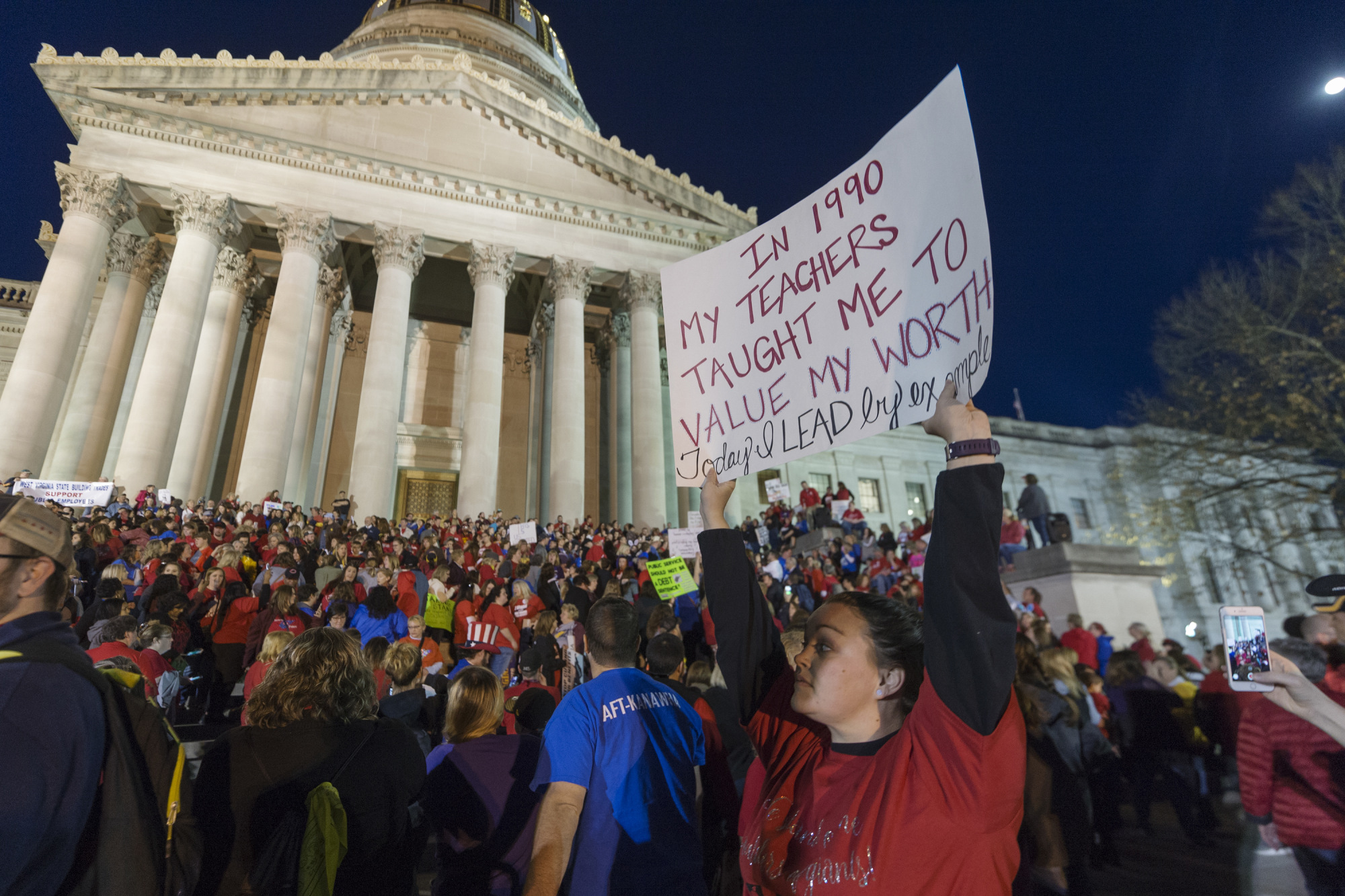
The West Virginia strike is over. The teachers and government employees clearly won. Workers that are unified and refuse to yield are usually in good shape in terms of having many of their demands met.
The West Virginia teachers got their 5% raise signed into law and by staying out an additional week, all government employees in the state will also get 5% increases.
In addition, a number of other anti-worker bills were not passed by the Republican controlled State Legislature.
This is from Portside:
The West Virginia teachers got their 5% raise signed into law and by staying out an additional week, all government employees in the state will also get 5% increases.
In addition, a number of other anti-worker bills were not passed by the Republican controlled State Legislature.
This is from Portside:
On Tuesday afternoon, a deal to give all public employees in the state of West Virginia a 5 percent pay raise was passed by the legislature and signed by the governor.
A struggle that mobilized tens of thousands of workers, won widespread popular support, and was led by rank-and-file leaders, ended in a tangible victory. Confusion arose, however, as reports indicated that Republican state politicians wanted to offset the increase with cuts to social services. But though the Republicans are threatening to pay for this in part through cutting essential services, the bill itself is not tied to any such cuts.
To assess the tentative strike settlement, Jacobin’s Eric Blanc sat down with Emily Comer and Jay O’Neal — teachers and union activists in Charleston, West Virginia.
EB
How did you hear the news about the deal?
EC
I woke up this morning to a call from my dad that said “Emily, this shit’s big. I listened to Hoppy Kercheval [an influential conservative talk radio host] on my way to work this morning. Hoppy’s on your side. He’s saying that the Senate needs to give in so that the kids can go back to school. If Hoppy’s turned, then the Senate is going to turn.” So I woke up feeling excited and hopeful.
JO
I was at the capitol. Around 9:45 in the morning I started getting texts from people saying that they heard on the radio that there’s some kind of press conference at ten o’ clock and that a deal had been made. Of course, I was originally skeptical. Then a Republican House delegate came up to me and said, “I worked really hard on this. And I think you’ll be happy.” But she wouldn’t tell me how much the deal was for. I said: “I hope we’re happy.”
So I went up to the crowd in front of the Senate to ask people what was going on. And all of a sudden I get a text from a teacher at my school that said: “5 percent for everyone!” Suddenly I heard cheering. I look up and see that the governor, who is a big man, was now standing in the middle of this huge crowd of teachers announcing a 5 percent raise for all public employees.
EB
How do strikers generally feel about the deal?
EC
Thrilled. We’re overwhelmed with emotion. I have broken down sobbing more times than I can count today. There’s probably video footage of me bawling while I’m surrounded by coworkers singing “Country Roads.” There’s almost a sense of disbelief, because for about a solid week there, we were really in unfamiliar territory. We didn’t know what was going to happen.
JO
After watching the conference committee last night, I didn’t wake up feeling positive about anything. I was worried the bill was actually going to get kicked back down to the 2 percent. And so now I’m excited, I’m thrilled, I feel like my life won’t ever be the same again. It sounds like hyperbole, but it’s not. Going back to the classroom won’t be the same now.
And what a lot of people have already forgotten is how much we have already won. Even before the walkouts began, in his hope to avoid a strike, the governor dropped his push for catastrophic changes to PEIA, such as the total family income requirement and the Go365 wellness program. The government was forced to keep the PEIA insurance premiums and deductibles at their current level. Also, because of the strike, we were able to ensure that a lot of bad education bills weren’t able to get passed. The charter school bill didn’t go anywhere, and additional anti-union bills like “payroll protection” all were dropped.
EB
What do you think brought about this victory?
EC
The first thing I would say is that West Virginians came together en masse and held each other up. My colleagues and I leaned on each other heavily — emotionally, for quick information, for everything. Our communities leaned on each other to feed kids, to provide childcare. Parents were patient and understanding, and that’s been a remarkable thing. The most amazing part of this struggle has been the real sense of community across West Virginia.
Further down in the article is a lesson for us all from the WVA teachers:
EC
For a successful mass movement, people don’t have to agree on partisan politics, on religion, or anything else for that matter. But they do have to come together and fight in solidarity around a shared issue. We’ve learned that people will push the other differences aside in the name of solidarity.
That is the lesson of West Virginia. May we learn it.
Tuesday, March 06, 2018
MAYOR SAYS SCHOOL IS OPEN WEDNESDAY
From Mayor Bill de Blasio via Twitter:
After receiving the latest forecast, we will keep @NYCSchools open tomorrow Wednesday, March 7. We will continue to monitor forecasts throughout the night.
Happy travels all.
Be safe please.
After receiving the latest forecast, we will keep @NYCSchools open tomorrow Wednesday, March 7. We will continue to monitor forecasts throughout the night.
Happy travels all.
Be safe please.
Monday, March 05, 2018
MULGREW OPTIMISTIC EMAIL ON NEW CHANCELLOR
In my inbox this evening:
Dear James,
Richard Carranza, the Houston schools superintendent, has been named the next New York City schools chancellor.
We are happy that Mayor de Blasio has chosen another career educator to succeed Carmen Fariña. Carranza, the child of Mexican immigrant parents, began as a bilingual social studies teacher in Arizona and worked his way up through the ranks to lead the San Francisco public schools for four years before his 18-month stint in Houston.
Carranza has earned a reputation for collaboration with educators and parents and has been a real champion of public schools. We are encouraged by his commitment to all children, his resistance to a “testing culture” and his support for the community schools approach.
In his remarks today at the City Hall press conference to announce his appointment, Carranza spoke about how he draws his inspiration and strength from the classroom. He stressed the importance of social and emotional learning and the arts in urban public schools. And he spoke persuasively about the support that “historically underserved” schools need to turn around.
In answering a question about charter schools, he made clear his own allegiance: “I am a vocal, voracious, absolutely passionate supporter of public schools.”
Both his track record and his words today are promising. We look forward to working with the new schools chancellor to continue to move our New York City public schools forward.
Thank you for everything that you do.
Sincerely,
Michael Mulgrew,
UFT President
RICHARD CARRANZA NAMED NEW CHANCELLOR
Houston School Superintendent Richard Carranza will be the new NYC Chancellor. His previous job was to head San Francisco public schools. I found some tidbits people might find interesting in some of the articles on Carranza.
From the San Francisco Chronicle when Carranza left to take the Houston job in 2016:
Here is Mulgrew's positive reaction from Chalkbeat:
Mr. Carranza has earned a reputation for collaboration with teachers, parents and school communities and has been a real champion of public schools. We are encouraged by his commitment to all children, his resistance to a “testing culture” and his support for the community schools approach.
From Houston Federation of Teachers President Zeph Capo and American Federation of Teachers President Randi Weingarten (Chalkbeat):
Houston's loss is New York City's gain. Under Superintendent Carranza's leadership and vision, we collaborated to strengthen and support public education in Houston. Together, we ended the teacher assessment sham that was VAM (value-added measures), and we coordinated to get schools aid and new books in the wake of Hurricane harvey. Richard worked tirelessly to help communities recover and heal, well after the floodwater receded. He was a proud servant of the children of Houston, and, if his track record is any guide, he'll be a similarly indispensable asset to the children of New York. While we're sad to see Richard leave Texas, we congratulate him on his appointment and New York City on its wise choice.
He looks like he will have the UFT on his side for what that is worth or not worth for the rest of us.
Oh and Carranza isn't on Eva Moskowitz' list of potential Chancellors.
On the down side from Politico:
Carranza has indicated that he's not against closing schools. He announced a hard-line approach for Houston's worst schools just two months ago, slating 15 schools for closure or takeover. And last year, Carranza announced a separate $24 million plan for 32 of the city's low-performing schools that sounds a great deal like the Renewal program: more professional development and instructional coaches for teachers and longer school days.
On Houston's budget shortfall, I'm not sure Carranza can be blamed. From Patch:
HISD is facing a $115 million budget shortfall for the 2018-19 school year for a variety of reasons, most notably Hurricane Harvey recapture, lower student enrollment and paying money back to the state for the "Robin Hood" law.
From the San Francisco Chronicle when Carranza left to take the Houston job in 2016:
The Houston Federation of Teachers expressed "cautious optimism" about working with Carranza. The union has been opposed to Houston's use of student test scores in teachers' job evaluations – a practice Carranza pledged not to support in San Francisco.
"Houston is different from San Francisco in some ways, and there will be a learning curve to understanding our community, but Carranza's track record of social justice will provide an important foundation on which to bring equity to our public schools," union president Zeph Capo said in a statement.
Not wanting to use student test scores in teacher job evaluations will put the Chancellor at odds with UFT President Michael Mulgrew but not with the vast majority of the teachers.Here is Mulgrew's positive reaction from Chalkbeat:
Mr. Carranza has earned a reputation for collaboration with teachers, parents and school communities and has been a real champion of public schools. We are encouraged by his commitment to all children, his resistance to a “testing culture” and his support for the community schools approach.
From Houston Federation of Teachers President Zeph Capo and American Federation of Teachers President Randi Weingarten (Chalkbeat):
Houston's loss is New York City's gain. Under Superintendent Carranza's leadership and vision, we collaborated to strengthen and support public education in Houston. Together, we ended the teacher assessment sham that was VAM (value-added measures), and we coordinated to get schools aid and new books in the wake of Hurricane harvey. Richard worked tirelessly to help communities recover and heal, well after the floodwater receded. He was a proud servant of the children of Houston, and, if his track record is any guide, he'll be a similarly indispensable asset to the children of New York. While we're sad to see Richard leave Texas, we congratulate him on his appointment and New York City on its wise choice.
He looks like he will have the UFT on his side for what that is worth or not worth for the rest of us.
Oh and Carranza isn't on Eva Moskowitz' list of potential Chancellors.
On the down side from Politico:
Carranza has indicated that he's not against closing schools. He announced a hard-line approach for Houston's worst schools just two months ago, slating 15 schools for closure or takeover. And last year, Carranza announced a separate $24 million plan for 32 of the city's low-performing schools that sounds a great deal like the Renewal program: more professional development and instructional coaches for teachers and longer school days.
On Houston's budget shortfall, I'm not sure Carranza can be blamed. From Patch:
HISD is facing a $115 million budget shortfall for the 2018-19 school year for a variety of reasons, most notably Hurricane Harvey recapture, lower student enrollment and paying money back to the state for the "Robin Hood" law.
Sunday, March 04, 2018
WEST VIRGINIA SENATE CUTS TEACHER RAISE TO 4%; STRIKE CONTINUES; BERNIE SANDERS BACKS WV TEACHERS
From The Associated Press via ABC News:
A joint legislative committee in West Virginia is set to address differences in pay raise bills for the state's striking teachers and school service personnel.
The teachers, who walked out of classrooms statewide starting Feb. 22, say they won't return to the classroom until lawmakers approve a 5 percent raise they negotiated with the governor.
On Saturday the Republican-controlled Senate voted for a 4 percent pay raise. The Republican-controlled House of Delegates earlier approved a 5 percent raise proposal that unions had negotiated with Gov. Jim Justice. House members later Saturday wouldn't agree to the Senate's move.
Two Republicans and one Democrat from each chamber will serve on the conference committee. House of Delegates spokesman Jared Hunt said Sunday no meeting had been scheduled. It wasn't yet clear when the committee would meet.
According to the state Department of Education, schools statewide have been canceled on Monday.
This is from WOAY TV in West Virginia:
BURLINGTON, Vt., March 3 – U.S. Sen. Bernie Sanders (I-Vt.) issued the following statement in support of the teachers on strike in West Virginia:
“Over a hundred years ago the coal miners of West Virginia helped lead the struggle in our country for fair wages and dignity on the job. Today, the teachers of West Virginia are carrying on that brave tradition. There is no more important work than educating our young people. The teachers of West Virginia, and teachers throughout our country, deserve decent salaries and affordable health care. I stand with the teachers of West Virginia in their fight for justice and dignity.”
THE UFT AFTER JANUS LOSS
We all expect the public sector unions to lose the Janus Supreme Court case by a vote of 5-4. If union dues become optional in the public sector, how will the Union leaders respond?
Most people expect the same old arrogance and disregard for the membership from the UFT hierarchy, especially in the high schools that often don't vote for Mulgrew's Unity Caucus. The officers probably figure they can bamboozle the rank and file as they have regularly done in the past (see 2005, 2014 contracts and 2013, 2017 evaluation systems for examples). There might be some show of militancy to soothe people like those that read this blog but it probably will not be too strong nor will it last. This will more than likely lead to many defections from the Union. However, maybe the leaders of the UFT can learn from history. I'm skeptical but I like to remain hopeful. Or, maybe the rank and file will force the center of gravity in the UFT to move in an activist direction.
From the Supreme Court oral argument in Janus we have our future pretty much laid out in front of us based on what has happened historically when unions have lost automatic dues collection from non-members. David Franklin is the the solicitor general of Illinois arguing for the unions and the justices ask him questions.
JUSTICE KAGAN: Mr. -- Mr. Franklin,
Mr. Messenger has suggested, and -- and -- and General Francisco, that if we overruled Abood (end agency fees for non union members), things would in a few years get back to normal. The state would pass a new statute, and these municipal contracts would all be renegotiated and it wouldn't be any real issue. So could you -- what do you think about that? What would the difficulties be, if any, if the state -- if -- if the Court were to overrule Abood?
MR. FRANKLIN: I'm happy to speak to that, Justice Kagan. Here's what we know, and, obviously, we're on a motion to dismiss, but more broadly, what we know is that tangibly, when these kinds of obligations of financial support become voluntary, union membership goes down, union density rates go down, union resources go down. We've seen it again and again. Mancur Olson spoke about it in the foundational text of behavioral economics. We also know that, intangibly, there are plenty of studies that show that when unions are deprived of agency fees, they tend to become more militant, more confrontational, they go out in search of short-term gains that they can bring back to their members and say stick with us.
That sounds positive but if we read on, the Franklin lays out a more pessimistic future.
CHIEF JUSTICE ROBERTS: Well, the argument on the other side, of course, is that the need to attract voluntary payments will make the unions more efficient, more effective, more attractive to a broader group of their employees. What's wrong with that?
MR. FRANKLIN: Well, two things that -- that I would say about that. First, the studies that I've read indicate that, yes, there can be an initial first flush of mobilization and organizing when something like this gets taken away, but that over the long term, human nature and basic economics dictate that the free-rider problem will become endemic and, not only that, but contagious, because if I'm an employee and I stick with a union and others over time decide not to, my fees and my dues are going to go up and up and up and the pressure on me to make the same choice will increase as well.
David Franklin has seen the future. The UFT will emerge from Janus and will probably at least try to fake militancy to get members to stay in the union. However, right wing advertisements will try to convince us to leave the UFT and as people see their wages and benefits won't be cut right away if they are not in the union, many will leave to save their dues money and tell others to do the same. The UFT will then be even weaker than it already is so the chances of getting a decent contract will be less than zero. That will lead to even more defections.
A smart union would say all hands on deck; we must stick together to save ourselves even if we all must make sacrifices, including the leadership who should reform by forming a coalition with many groups within the union. It is hard to see the UFT leadership going in this direction. They have been far too pompous for far too long. They have no accountability because we in the opposition have no way to reach the almost 200,000 members of the UFT. Therefore, we could never compete in an election except in the high schools where members know us and we often win on a platform of a more militant union.
Maybe Janus will sober Mulgrew and Unity Caucus up, but a better way to do that would be for us to start a grassroots movement from below to ensure real militancy. It is happening in West Virginia, a right to work state. It can happen in union friendly, progressive NY. We need to lead from the ground.
Most people expect the same old arrogance and disregard for the membership from the UFT hierarchy, especially in the high schools that often don't vote for Mulgrew's Unity Caucus. The officers probably figure they can bamboozle the rank and file as they have regularly done in the past (see 2005, 2014 contracts and 2013, 2017 evaluation systems for examples). There might be some show of militancy to soothe people like those that read this blog but it probably will not be too strong nor will it last. This will more than likely lead to many defections from the Union. However, maybe the leaders of the UFT can learn from history. I'm skeptical but I like to remain hopeful. Or, maybe the rank and file will force the center of gravity in the UFT to move in an activist direction.
From the Supreme Court oral argument in Janus we have our future pretty much laid out in front of us based on what has happened historically when unions have lost automatic dues collection from non-members. David Franklin is the the solicitor general of Illinois arguing for the unions and the justices ask him questions.
JUSTICE KAGAN: Mr. -- Mr. Franklin,
Mr. Messenger has suggested, and -- and -- and General Francisco, that if we overruled Abood (end agency fees for non union members), things would in a few years get back to normal. The state would pass a new statute, and these municipal contracts would all be renegotiated and it wouldn't be any real issue. So could you -- what do you think about that? What would the difficulties be, if any, if the state -- if -- if the Court were to overrule Abood?
MR. FRANKLIN: I'm happy to speak to that, Justice Kagan. Here's what we know, and, obviously, we're on a motion to dismiss, but more broadly, what we know is that tangibly, when these kinds of obligations of financial support become voluntary, union membership goes down, union density rates go down, union resources go down. We've seen it again and again. Mancur Olson spoke about it in the foundational text of behavioral economics. We also know that, intangibly, there are plenty of studies that show that when unions are deprived of agency fees, they tend to become more militant, more confrontational, they go out in search of short-term gains that they can bring back to their members and say stick with us.
That sounds positive but if we read on, the Franklin lays out a more pessimistic future.
CHIEF JUSTICE ROBERTS: Well, the argument on the other side, of course, is that the need to attract voluntary payments will make the unions more efficient, more effective, more attractive to a broader group of their employees. What's wrong with that?
MR. FRANKLIN: Well, two things that -- that I would say about that. First, the studies that I've read indicate that, yes, there can be an initial first flush of mobilization and organizing when something like this gets taken away, but that over the long term, human nature and basic economics dictate that the free-rider problem will become endemic and, not only that, but contagious, because if I'm an employee and I stick with a union and others over time decide not to, my fees and my dues are going to go up and up and up and the pressure on me to make the same choice will increase as well.
David Franklin has seen the future. The UFT will emerge from Janus and will probably at least try to fake militancy to get members to stay in the union. However, right wing advertisements will try to convince us to leave the UFT and as people see their wages and benefits won't be cut right away if they are not in the union, many will leave to save their dues money and tell others to do the same. The UFT will then be even weaker than it already is so the chances of getting a decent contract will be less than zero. That will lead to even more defections.
A smart union would say all hands on deck; we must stick together to save ourselves even if we all must make sacrifices, including the leadership who should reform by forming a coalition with many groups within the union. It is hard to see the UFT leadership going in this direction. They have been far too pompous for far too long. They have no accountability because we in the opposition have no way to reach the almost 200,000 members of the UFT. Therefore, we could never compete in an election except in the high schools where members know us and we often win on a platform of a more militant union.
Maybe Janus will sober Mulgrew and Unity Caucus up, but a better way to do that would be for us to start a grassroots movement from below to ensure real militancy. It is happening in West Virginia, a right to work state. It can happen in union friendly, progressive NY. We need to lead from the ground.
Saturday, March 03, 2018
ARE OKLAHOMA TEACHERS NEXT ONES WHO WILL WALK OUT?
This story came to us from our reader Pogue via KTUL - Tulsa, Oklahoma. It appears West Virginia has started a militant public school teacher movement that might be contagious.
MOORE, Okla. (KTUL)--Oklahoma teachers are fed up with state lawmakers. A public school teacher in Stillwater created the Facebook group "Oklahoma Teacher Walkout - The Time is Now!" two days ago, and it has already gained more than 20,000 members.
When are we in NY going to join this movement for action that started in West Virginia and now appears to be spreading?
Don't expect Michael Mulgrew to lead it. The West Virginia teachers' strike is buried as about the 25th story in this week's Chapter Leader Update. This after Executive Board member Mike Schirtzer introduced an amendment I wrote to a UFT resolution in support of the WVA teachers stating that the Union "will publicize the courageousness of the WV teachers to help educate our members about the power of union activism, including strikes, even when they are illegal." This amendment passed unanimously at the Exec Bd.
The UFT at least gave us some lip service but the WV paragraph came under such "important" stories as applying for peer evaluator positions so you can observe teachers rated ineffective and a Share My Lesson virtual conference. From what I saw in the weekly NYSUT Update, there is nothing on WV. There is nothing in NEA INsider either.
My point is any movement in NY will have to come from the ground, not from the leadership.
MOORE, Okla. (KTUL)--Oklahoma teachers are fed up with state lawmakers. A public school teacher in Stillwater created the Facebook group "Oklahoma Teacher Walkout - The Time is Now!" two days ago, and it has already gained more than 20,000 members.
Today, teachers gathered in Moore to discuss the possible statewide strike.
"Frustration levels are high, so a strike is not a touchy word anymore," said Molly Jaynes, a teacher in Oklahoma City.
Don't expect Michael Mulgrew to lead it. The West Virginia teachers' strike is buried as about the 25th story in this week's Chapter Leader Update. This after Executive Board member Mike Schirtzer introduced an amendment I wrote to a UFT resolution in support of the WVA teachers stating that the Union "will publicize the courageousness of the WV teachers to help educate our members about the power of union activism, including strikes, even when they are illegal." This amendment passed unanimously at the Exec Bd.
The UFT at least gave us some lip service but the WV paragraph came under such "important" stories as applying for peer evaluator positions so you can observe teachers rated ineffective and a Share My Lesson virtual conference. From what I saw in the weekly NYSUT Update, there is nothing on WV. There is nothing in NEA INsider either.
My point is any movement in NY will have to come from the ground, not from the leadership.
JANUS AND WEST VIRGINIA LINKED
Bloomberg has an interesting piece tying together the Janus case with the West Virginia teachers' strike that Reality Based Educator sent me this morning.
From the Josh Eidelson article:
A week ago, thousands of public school teachers in West Virginia went out on strike, a rare but familiar union-organized action to protest low wages and rising health-care costs. Tuesday night, state union leaders and the Governor Jim Justice reached a deal, and the teachers were expected to be back at work on Thursday.
They didn’t go.
Unsatisfied with the resolution, they stayed on the picket line, mounting one of the country’s biggest unauthorized “wildcat” strikes in decades. “I think that teachers had just finally had enough,” said striking English teacher Erica Rodeheaver.
A week ago, thousands of public school teachers in West Virginia went out on strike, a rare but familiar union-organized action to protest low wages and rising health-care costs. Tuesday night, state union leaders and the Governor Jim Justice reached a deal, and the teachers were expected to be back at work on Thursday.
They didn’t go.
Unsatisfied with the resolution, they stayed on the picket line, mounting one of the country’s biggest unauthorized “wildcat” strikes in decades. “I think that teachers had just finally had enough,” said striking English teacher Erica Rodeheaver.
And the action is continuing as the State Senate has not acted on the 5% raise that the Governor agreed to.
Is this our future after the Supreme Court in the Janus case will more than likely take agency fees away from unions in the public sector to further weaken us?
It might be. Back to the Eidelson piece:
As uncommon as work stoppages have become in the U.S., big wildcat strikes like West Virginia’s are almost unheard of. It arrives at a moment when organized labor, already in steep decline, is facing a new emergency: The Supreme Court heard arguments Monday in a case that’s expected by June to end mandatory union fees for all government employees, an outcome that would slash unions’ budgets and power.
Against this backdrop, the strike in West Virginia, where unions lack both mandatory fees and formal collective bargaining rights, has become for some a beacon, an example of the type of disruptive activism that could keep the labor movement alive.
“I think it’s the most important thing going on in the labor movement in recent years,” said Joe Burns, the director of bargaining for the Association of Flight Attendants. “I think it presents a path forward for the labor movement: solidarity and strike action.”
Is this our future after the Supreme Court in the Janus case will more than likely take agency fees away from unions in the public sector to further weaken us?
It might be. Back to the Eidelson piece:
As uncommon as work stoppages have become in the U.S., big wildcat strikes like West Virginia’s are almost unheard of. It arrives at a moment when organized labor, already in steep decline, is facing a new emergency: The Supreme Court heard arguments Monday in a case that’s expected by June to end mandatory union fees for all government employees, an outcome that would slash unions’ budgets and power.
Against this backdrop, the strike in West Virginia, where unions lack both mandatory fees and formal collective bargaining rights, has become for some a beacon, an example of the type of disruptive activism that could keep the labor movement alive.
“I think it’s the most important thing going on in the labor movement in recent years,” said Joe Burns, the director of bargaining for the Association of Flight Attendants. “I think it presents a path forward for the labor movement: solidarity and strike action.”
Further down:
This kind of workplace turbulence could become more common if the Supreme Court gets rid of mandatory fees, a decision that would make more of the country “right-to-work.” Many states legalized collective bargaining and mandatory fees in hopes of averting wildcat disruptions and securing “labor peace,” and they largely have.
If more moderate members decline to fund their unions, the remaining members could prove more eager for aggressive action. If unions can’t get the state to guarantee they can collect fees from everyone they’re representing, they could be more hesitant to give the state a guarantee that their members won’t strike. And if some unions give up their right to represent non-members and reboot as “members-only” groups advocating just for those who pay dues, unions could end up in competition with one another, trying to outdo each other with more militant, demonstrative protests.
Why wait for the Supreme Court to take us down? It's the rank and file that have to bring this militancy on.
From a comment on our last piece on West Virginia:
Hell yes, we strike. De Blasio already tipped his hand with the Carvahlo pick. He tried to sneak in a test based commission pay system in the middle of the night during our contract year. It’s time we up our demands. We want a restoration of our pension to at least Tier 2 levels, an elimination of test based evaluations, full raises, and the same paid maternity that all state workers get (with leave replacements that end the current system of coerced overtime). We also want a restoration of our health benefits to eliminate the 200% increase in copays for ER visits he instituted. How many teachers died because they were afraid to go to the ER for chest pains? A dead teacher is cheaper to insure than a live one, but, that’s a disgusting way to save a buck. Forget this mayor. He’s term limited out and he thinks Eva Moskowitz will gin up donors for the next stage in his life. He’s set us up to get screwed, and we need to be ready to walk. Remember, he settled our last retro contract in Hail Mary pass to extend expiration beyond his re-election. Now we are seeing exactly why he did that. Add to that the fact that he has preserved test based evals long after the RttT.
A few lines later:
I know someone will bring up the ‘75 strike. But, all others led to gains while ‘75 was meant to stop the bleeding in a fiscal crisis. The City is now flush with a big surplus and a booming stock market. If we let ourselves get hosed now, we are done. There is no end. I know some normally conservative Rank and File who are ready to fight back. They hate de Blasio, they’re emboldened by West Virginia (I’m shocked by who amongst my colleagues have been following the story there), and they’ve had enough. We need to start taking to each other about striking. I’m hearing people talk about it, and I say we make them feel even more comfortable saying it out loud.
I understand we make considerably more money than West Virginia teachers so we have more to lose but our working conditions are deteriorating in NY.
Do we want to stop the bleeding?
If we really want to get the evaluation system straightened out and get respected again, the time to step forward is right about now. If we wait for Mulgrew/Unity to fix the mess, we will be waiting a long, long time.
Thursday, March 01, 2018
WEST VIRGINIA TEACHERS' STRIKE CONTINUING
The West Virginia teachers' strike goes on.Union leadership settled things with the governor and announced the strike was done on Tuesday but they didn't bother to ask the membership. When they did, the members said there is no deal and they didn't return to work. Teachers aren't taking anything for granted.
Promises from the governor of a 5% raise are not enough. They have stayed out on strike now for over a week. Teachers and other support personnel want to know there is a done deal with the State Legislature before they return to work. Many are also concerned about the health benefits issue where only a task force has been set up to deal with the Public Employees Insurance Agency health insurance coverage.
This is becoming a more amazing story as it enters its second week.
Jacobin interviewed teacher Jay O'Neal.
On Tuesday night, it was announced that the strike was resolved. Can you tell us about how things played out here on the ground?
Many of us were protesting at the capitol on early Tuesday afternoon, and we decided to stay because word spread that NBC News would be filming live at 6 PM. We also knew that the union leadership was meeting at this time with the governor. But nobody knew what would happen. Up until this point, the governor had been obstinate — he kept insisting that nothing could be done to meet our demands.
So while the union leaders were with the governor, we were all out on the steps, waiting for the NBC newscast to start. There was a big crowd. As is the case these days, everybody was on their phones, trying to follow the news to get a sense of what was going on.
Within ten minutes, we found out through the governor’s press conference that a deal had been reached. Teachers and school staff would get a 5 percent pay raise, and 3 percent for all state employees. The governor also said that a task force would be set up to figure out how to improve PEIA, our statewide health insurance plan for public sector workers.
Fifteen minutes after the press conference, union leaders came out and addressed the crowd. The basic problem was that they presented this deal as a victory. They told us we’d be out on strike one more day, then return to school on Thursday.
People were up in arms, really frustrated. Of course, a 5 percent raise is great, but what we’ve been really fighting for in this struggle is PEIA. This has been a huge issue, causing problems for years. They’ve been cutting our health insurance over and over, making it really expensive to survive.
So when it was announced that all we got on PEIA was a task force, people were upset. Teachers in the crowd started interrupting and yelling at our leaders: “We’re not going back in for that!” Everyone started chanting, “We are the union bosses! We are the union bosses!” and “Back to the table! Back to the table!”
Strikers now have a sense of our power, and we don’t want to back down. We weren’t satisfied with the deal. Again, this is mainly because of the health insurance. People are nervous and rightly cynical that the state government has any actual intention to fix this. A lot of teachers are now awakening to what’s happening at our statehouse.We need to see real movement, real solutions, for PEIA. We need a new revenue source. A lot of us have been saying that the solution is a severance tax on natural gas. This would only tax the big out-of-state corporations, not ordinary West Virginians.
Another teacher is quoted in the Charleston Gazette Mail. His view is a little different:
Workers interviewed Thursday had different ideas of what would persuade them to return (to work).
Nick Watts, a teacher at Kanawha County's Sissonville High, said of the idea to turn HB4145 (the 5% salary increase bill) into a PEIA funding bill that "It sounds like there's a lot more risk involved for us in that situation than just giving a raise"
Watts said the raise would seemingly be more guaranteed to continue to be funded, and said diverting that money to a PEIA fund next fiscal year could mean that same amount of money won't be allocated there in future years, and could mean money might be recalled from the fund.
"What's the guarantee that that money actually finds its way into the PEIA problem?" Watts asked. "That's a question I would like to see answered."
He said that "with the raise, it's there and we know it's there, and it's a guarantee now until it's written out of the (state) code.A one-time $58 million into the PEIA trust fund, if there’s no guarantee that that’s going to be something that’s continual, then I don’t see that as a fix for PEIA.”
Promises from the governor of a 5% raise are not enough. They have stayed out on strike now for over a week. Teachers and other support personnel want to know there is a done deal with the State Legislature before they return to work. Many are also concerned about the health benefits issue where only a task force has been set up to deal with the Public Employees Insurance Agency health insurance coverage.
This is becoming a more amazing story as it enters its second week.
Jacobin interviewed teacher Jay O'Neal.
On Tuesday night, it was announced that the strike was resolved. Can you tell us about how things played out here on the ground?
Many of us were protesting at the capitol on early Tuesday afternoon, and we decided to stay because word spread that NBC News would be filming live at 6 PM. We also knew that the union leadership was meeting at this time with the governor. But nobody knew what would happen. Up until this point, the governor had been obstinate — he kept insisting that nothing could be done to meet our demands.
So while the union leaders were with the governor, we were all out on the steps, waiting for the NBC newscast to start. There was a big crowd. As is the case these days, everybody was on their phones, trying to follow the news to get a sense of what was going on.
Within ten minutes, we found out through the governor’s press conference that a deal had been reached. Teachers and school staff would get a 5 percent pay raise, and 3 percent for all state employees. The governor also said that a task force would be set up to figure out how to improve PEIA, our statewide health insurance plan for public sector workers.
Fifteen minutes after the press conference, union leaders came out and addressed the crowd. The basic problem was that they presented this deal as a victory. They told us we’d be out on strike one more day, then return to school on Thursday.
People were up in arms, really frustrated. Of course, a 5 percent raise is great, but what we’ve been really fighting for in this struggle is PEIA. This has been a huge issue, causing problems for years. They’ve been cutting our health insurance over and over, making it really expensive to survive.
So when it was announced that all we got on PEIA was a task force, people were upset. Teachers in the crowd started interrupting and yelling at our leaders: “We’re not going back in for that!” Everyone started chanting, “We are the union bosses! We are the union bosses!” and “Back to the table! Back to the table!”
Strikers now have a sense of our power, and we don’t want to back down. We weren’t satisfied with the deal. Again, this is mainly because of the health insurance. People are nervous and rightly cynical that the state government has any actual intention to fix this. A lot of teachers are now awakening to what’s happening at our statehouse.We need to see real movement, real solutions, for PEIA. We need a new revenue source. A lot of us have been saying that the solution is a severance tax on natural gas. This would only tax the big out-of-state corporations, not ordinary West Virginians.
Another teacher is quoted in the Charleston Gazette Mail. His view is a little different:
Workers interviewed Thursday had different ideas of what would persuade them to return (to work).
Nick Watts, a teacher at Kanawha County's Sissonville High, said of the idea to turn HB4145 (the 5% salary increase bill) into a PEIA funding bill that "It sounds like there's a lot more risk involved for us in that situation than just giving a raise"
Watts said the raise would seemingly be more guaranteed to continue to be funded, and said diverting that money to a PEIA fund next fiscal year could mean that same amount of money won't be allocated there in future years, and could mean money might be recalled from the fund.
"What's the guarantee that that money actually finds its way into the PEIA problem?" Watts asked. "That's a question I would like to see answered."
He said that "with the raise, it's there and we know it's there, and it's a guarantee now until it's written out of the (state) code.A one-time $58 million into the PEIA trust fund, if there’s no guarantee that that’s going to be something that’s continual, then I don’t see that as a fix for PEIA.”
Watts said he defines “fix for PEIA” as a long-term, dedicated funding source that keeps any benefit cuts or cost increases that do occur manageable into the future.
He did say he’d be in favor of returning to work tomorrow if the bill passed as the House passed it, saying “to me personally, this would be a show of good faith” -- though he said he’d stand with the local American Federation of Teachers union branch he’s a member of if it decided to continue striking.
While Watts was talking to a reporter, the crowd outside the Senate chamber was chanting “We’re not leaving."
This is so inspiring to see how workers really do have power. On the other hand, it is kind of frustrating because teachers in NY give every excuse in the book on why we can't pull off anything remotely like a job action. We would do much better if we organized for a real fight.
CARVALHO TURNS DOWN NYC CHANCELLOR JOB
Nothing should surprise us any longer in education. Today, Alberto Carvalho turned down the NYC Chancellor position. He decided to stay in Miami. He probably made a sound decision.
Mayor Bill de Blasio now is 0 for 2 on Chancellor picks with Carmen Farina and now the pro charter Carvalho. Maybe the mayor can get this right when he chooses a third time.
No dancing in the streets here as Farina probably stays longer.
Mayor Bill de Blasio now is 0 for 2 on Chancellor picks with Carmen Farina and now the pro charter Carvalho. Maybe the mayor can get this right when he chooses a third time.
No dancing in the streets here as Farina probably stays longer.
Wednesday, February 28, 2018
NEW CHANCELLOR LOOKS LIKE MORE OF THE SAME
Mayor Bill de Blasio has picked the new Chancellor. He is Alberto Carvalho. Politico, ABC 7 and other media outlets have profiles on Carvalho who has led the Miami Dade schools since 2008 when he took over from former NYC Chancellor Rudy Crew. Carvalho will succeed retiring Carmen Farina next month.
Since Carvelho won a not so prestigious award from Eli Broad, a notorious anti-teacher reformer, Carvalho might be automatically disqualified from any pro-public school list of possible Chancellors. Add to this his support for school choice and his placement on Eva Moskowitz list of acceptable Chancellor candidates and this does not bode well. There probably aren't going to be any major changes from the disastrous policies that have plagued NYC schools since 2002 or maybe even 1999 when Crew left. Carvalho's claims to fame are that he lowered the achievement gap for English Language Learners and raised the high school graduation rate to record highs in Miami.
As far as Carvalho's relations with the teachers union goes, the Politico piece says this:
In 2011, Carvalho helped implement a merit pay system — considered anathema to most teachers union officials, including (AFT President Randi) Weingarten — that tied raises to teachers' evaluation scores and provided bonuses for highly effective teachers. He had occasional confrontations with groups of teachers upset about pay issues and rising health care costs. And he was sometimes at odds with the leadership of Miami’s local teachers union, United Teachers of Dade. After Miami-Dade schools and the union settled a new contract late last year, Carvalho praised the deal while UTD President Karla Hernández-Mats said, “It is absolutely not what our members deserve.”
As we head into discussions on a new contract in NYC with a contract ending late this year and considering we will most likely lose members when the Supreme Court probably lets public employees stop paying union dues, I think we can safely say the road ahead is not going to be easy.
Our best hope is a renewed militancy among the members.
Tuesday, February 27, 2018
WEST VIRGINIA TEACHERS TO GET 5% RAISE (Updated)
From CBS:
CHARLESTON, WV (WOWK) - West Virginia Governor Jim Justice announces teachers will go back to work on Thursday and teachers will get a five percent raise.
Gov. Justice says that they are taking Wednesday as a "cooling off day" because some counties have already canceled school.
According to his proposal, all state employees will receive a three percent raise, and any employees related to education will receive an additional two percent raise.
From further down in the updated article
(Governor) Justice's chief of staff says thanks to the president's tax plan, Governor's roadbond and improving GDP - revenue has been up these last two months. So now the state is expected to bring in $58-million more dollars this year. That money will go towards the raises.
$58 million magically found. I think the strike had something to do with that.
The Legislature still has to vote on the raises and there are other issues besides pay. However, I think it is clear that this illegal strike over money where the union held out and got the government to up its offer from 2% to 5% was successful. Educators also are getting 2% more than other government workers.
Can WV now be the go to model to look at on how to do an effective job action?
More on the strike from CNN.
(Governor) Justice's chief of staff says thanks to the president's tax plan, Governor's roadbond and improving GDP - revenue has been up these last two months. So now the state is expected to bring in $58-million more dollars this year. That money will go towards the raises.
$58 million magically found. I think the strike had something to do with that.
The Legislature still has to vote on the raises and there are other issues besides pay. However, I think it is clear that this illegal strike over money where the union held out and got the government to up its offer from 2% to 5% was successful. Educators also are getting 2% more than other government workers.
Can WV now be the go to model to look at on how to do an effective job action?
More on the strike from CNN.
13 SCHOOLS FACE CLOSURE AT PEP WEDNESDAY
The notice below came from MORE. I despise school closings for what it does to students, families, teachers and communities. I am in exile because Jamaica HS was unfairly closed.
Since Mayor deBlasio is going after 13 schools, we are approaching Bloomberg territory for closings. Fight as best as you are able to but mayoral control of schools is the real problem here. Until we have more than just the mayor to appeal to, nothing much will change.
Since Mayor deBlasio is going after 13 schools, we are approaching Bloomberg territory for closings. Fight as best as you are able to but mayoral control of schools is the real problem here. Until we have more than just the mayor to appeal to, nothing much will change.
Come to the PEP Meeting this Wed. Feb. 28
in Lower Manhattan, adjacent to the Brooklyn Bridge and City Hall
This Wed., Feb. 28, the Panel of Educational Policy (PEP ) will vote on the proposals to close 13 community schools. It is very important for as many folks as possible to attend this meeting to show support for the school communities that would be adversely affected by these actions.
There will be a press conference and rally against school closings before the PEP at 5:30 and you can sign up to speak at the PEP at that time as well.
MORE/CASCADE (Coalition Against School Closings and Displacement Everywhere) is fighting against the current round of school closings in NYC. We are against labeling any schools as "failing," against Renewal and Receivership School programs that don't help, against targeting these schools for Charter Co-locations, and against closures. We see the connection between school closures and the privatization of our education system as well as the anti-displacement movement.The next meeting of CASCADE, Campaign Against School Closures and Against Displacement Everywhere., is on March 10, at 2:30 at the CUNY Graduate Center. All are welcome to come and strategize about how to stop school closings.
Monday, February 26, 2018
PUBLIC SECTOR UNIONS HAVE BAD DAY BEFORE SUPREME COURT
We knew the Janus case was coming. Today the Supreme Court heard oral arguments. Remember, the public sector unions dodged a bullet back in 2016 when Justice Scalia died. The Supreme Court then split 4-4 on keeping agency fees (fees paid by non members) legal for unions in the Friedrichs case. After reading today's oral arguments in the nearly identical Janus case, I think I can say without too much reservation that things did not go well for the unions.
Unless there is a miracle, each one of us will get to decide if we want to pay union dues or not in the not too distant future. Make no mistake about it, the unions, whether we like the leadership or not, will be weakened.
Janus is arguing that paying union dues if he is not a union member is compelling him to associate against his will with an organization and thus speak against his will. This he claims violates his First Amendment rights. The unions counter that since non-members benefit from what unions do, they should have to pay for it. They cite Abood as a 1977 9-0 precedent where the Supreme Court said agency fees for non-union members were constitutional.
That was in a different time back in 1977. By getting soft and trying to play concessionary games with the powers that be, unions have gotten nowhere. Today just confirmed that.
Justice Anthony Kennedy, often the swing vote, lays out the conservative goals in this excerpt from today's oral argument from the SCOTUS blog that I think gets to the core of the matter.
When Illinois solicitor general David Franklin took his turn at the lectern, Kennedy – who is often regarded as a key vote in high-profile cases – left little doubt about where he stood. “What we are talking about here,” Kennedy said sternly, “is compelled justification and compelled subsidization of a private party, a private party that expresses political views constantly.” Later on, Kennedy asked attorney David Frederick, who appeared on behalf of the union, whether, if the unions lose, they “will have less political influence.” When Frederick answered “yes,” Kennedy shot back, “Isn’t that the end of this case?”
Unless Donald Trump appointee Neil Gorsuch is a closet liberal, this case is over and it's time to think about a post Janus world for government employees.
If you are hoping the unions lose so you can stop paying dues, all I can say is be careful what you wish for, you may very well get it.
Kennedy explained what this case is all about: decreasing working peoples' political influence.
For those who want to read the entire transcript of today's oral arguments, go here.
Unless there is a miracle, each one of us will get to decide if we want to pay union dues or not in the not too distant future. Make no mistake about it, the unions, whether we like the leadership or not, will be weakened.
Janus is arguing that paying union dues if he is not a union member is compelling him to associate against his will with an organization and thus speak against his will. This he claims violates his First Amendment rights. The unions counter that since non-members benefit from what unions do, they should have to pay for it. They cite Abood as a 1977 9-0 precedent where the Supreme Court said agency fees for non-union members were constitutional.
That was in a different time back in 1977. By getting soft and trying to play concessionary games with the powers that be, unions have gotten nowhere. Today just confirmed that.
Justice Anthony Kennedy, often the swing vote, lays out the conservative goals in this excerpt from today's oral argument from the SCOTUS blog that I think gets to the core of the matter.
When Illinois solicitor general David Franklin took his turn at the lectern, Kennedy – who is often regarded as a key vote in high-profile cases – left little doubt about where he stood. “What we are talking about here,” Kennedy said sternly, “is compelled justification and compelled subsidization of a private party, a private party that expresses political views constantly.” Later on, Kennedy asked attorney David Frederick, who appeared on behalf of the union, whether, if the unions lose, they “will have less political influence.” When Frederick answered “yes,” Kennedy shot back, “Isn’t that the end of this case?”
Unless Donald Trump appointee Neil Gorsuch is a closet liberal, this case is over and it's time to think about a post Janus world for government employees.
If you are hoping the unions lose so you can stop paying dues, all I can say is be careful what you wish for, you may very well get it.
Kennedy explained what this case is all about: decreasing working peoples' political influence.
For those who want to read the entire transcript of today's oral arguments, go here.
SCOTT STRINGER'S LATEST REPORT SHOWS CITY HAS $2.6 BILLION SURPLUS
The NYC economy continues to grow. Comptroller Scott Stringer has released a report showing the current city surplus is $2.6 billion. That's not quite a record and it is down but it isn't bad.
Of course with municipal labor contracts due and Donald Trump in the White House, Stringer's report is filled with all kinds of warnings. However even with a smaller surplus, the reality right now is the city is still doing well economically. I haven't read too many economists who think the recession is right around the corner.
In terms Of the Deparment of Education, Stringer's report says this:
Of course with municipal labor contracts due and Donald Trump in the White House, Stringer's report is filled with all kinds of warnings. However even with a smaller surplus, the reality right now is the city is still doing well economically. I haven't read too many economists who think the recession is right around the corner.
In terms Of the Deparment of Education, Stringer's report says this:
DOE: More for the Classroom, Less for the Bureaucracy
- Since 2012, Central Administration staff has increased by more than 400, a 24% rate of growth – twice the rate of teaching staff growth, at 12%.
- There is rampant waste and lack of accountability at DOE. Comptroller audits have found:
- In a sample of just 8 schools and one administrative site, one-third of computer hardware was unaccounted for, with no follow-up action to implement basic controls;
- $1 billion investment in high-speed broadband while one in three teachers remain dissatisfied with the service; and
- $2.7 billion in no-bid contracts.
Is anyone surprised by anything here?
Sunday, February 25, 2018
WEST VIRGINIA ILLEGAL STRIKE CONTINUING
The teachers of West Virginia are leading the way with their strike that will continue for a third day on Monday.
This is from AFT WV President Christine Campbell who is quoted in the Washington Post:
“They’re having an open dialogue with these people,” Campbell said. “I just believe that it’s time. We’ve seen some complacency over the years, because they didn’t feel like the people are listening to their voice. Now that they have stood up . . . I’m so thrilled that they are actually talking with their representatives and their representatives are talking with their constituents and hearing their concerns.”
Does that sound familiar NYC teachers? Nobody is listening to us either and complacency defines many teachers in NYC. Yes our salaries are better than West Virginia but our working conditions are worsening each day in NYC in so many schools.
This is from AFT WV President Christine Campbell who is quoted in the Washington Post:
“They’re having an open dialogue with these people,” Campbell said. “I just believe that it’s time. We’ve seen some complacency over the years, because they didn’t feel like the people are listening to their voice. Now that they have stood up . . . I’m so thrilled that they are actually talking with their representatives and their representatives are talking with their constituents and hearing their concerns.”
Does that sound familiar NYC teachers? Nobody is listening to us either and complacency defines many teachers in NYC. Yes our salaries are better than West Virginia but our working conditions are worsening each day in NYC in so many schools.
It looks like the question in WV is if they can hold out longer than the government. Their 1990 strike later eleven days. In NYC, it is about whether we will stand up for ourselves. We certainly cannot expect our union leaders to stand up for us.
Friday, February 23, 2018
TEACHER EVALUATION LAW DISCUSSED IN ALBANY
Chalkbeat covered changing the NYS teacher evaluation law. Our state union NYSUT is leading the fight to change the law. NYSUT wants the state to end mandates from Albany on eval and put it back to individual districts with student test results out of the mix.
Noticably absent from the discussion is the UFT. Although the UFT voted for the NYSUT resolution to get testing out of evaluations, UFT President Michael Mulgrew is now leading the charge to keep the current system in place. He says the NYC evaluation system could be a model for the state.
As for the petition people are looking for from us on repealing the evaluation law, I have been asking around. Do we go to repeal everything in 2015 law (eval, CTLE hours, four years probation, receivership), or do we go after just evaluations? Let us choose our target now folks.
ICE is meeting later today. I am still out of town but hopefully eval will come up.
Noticably absent from the discussion is the UFT. Although the UFT voted for the NYSUT resolution to get testing out of evaluations, UFT President Michael Mulgrew is now leading the charge to keep the current system in place. He says the NYC evaluation system could be a model for the state.
As for the petition people are looking for from us on repealing the evaluation law, I have been asking around. Do we go to repeal everything in 2015 law (eval, CTLE hours, four years probation, receivership), or do we go after just evaluations? Let us choose our target now folks.
ICE is meeting later today. I am still out of town but hopefully eval will come up.
Thursday, February 22, 2018
TEACHERS AND OTHER PUBLIC EMPLOYEES STRIKE IN WEST VIRGINIA; COULD WE DO THAT IN NYC?
Teachers in West Virginia went out on strike in an illegal action today. It was more than just the teachers participating in the two day illegal job action. Here is an account from WVMetroNews.
Charleston W.Va.-- The storm that's about to happen hasn’t hit West Virginia for almost 30 years.
Today, thousands of teachers and service personnel will be on the picket line — rather than in the classroom — all over West Virginia.
The last time that happened was 1990 — and even then it was only the teachers.
This time it’s bus drivers, school cooks, maintenance workers, teachers and other school employees from all of West Virginia’s 55 counties.
Here are the numbers for those who could be rallying at the Capitol or on picket lines at their schools:
18,900 classroom teachers.
If you include classroom teachers and principals and administrators, it’s 24,000.
Then mix in 13,500 service workers.
“We can’t stop this,” Joe White, executive director of the West Virginia School Service Personnel Association, told members of the West Virginia Board of Education during an emergency meeting on Wednesday.
It looks like it is the Teachers leading the way with other public employees coming along. Their salaries and benefits are decided statewide in WV.
Our wages in NYC in the public sector are done through pattern bargaining. One union settles on a salary increase, or a freeze, and the rest are forced to adhere to the pattern.
We can stipulate that our wages and benefits in NYC are better than public employees in WV but our working conditions have consistently been deteriorating and will continue to unless we step up. Why wait?
Cue some dream state music here please.
Imagine what would happen if instead of accepting this pattern bargaining system, all of the city workers bargained together to demand good contracts and we were ready to strike to get them? The city might have to find a way to treat us with some real respect.
I will even concede that since we have issues with our management, we can exclude the management unions from our grand coalition. Put Teachers with Sanitation, DC37 and the rest. It is my imagination so I will even include Police, Fire and Corrections. Oh what a powerful group of unions it would be.
We could tell the mayor: "To hell with the Taylor Law." Throw in Transit (I know they negotiate with state), we could easily be European style unions. Think France.
Nobody would be worried about people leaving the unions because the Supreme Court will soon say we can.
Now I am waking up. Back to reality. I am in the UFT. DC37 will probably soon get a contract with lousy raises and we will go through a long song and dance and get the same contract as will the Police and everyone else in the municipal workforce.
West Virginia public employees are showing a different path today. We should learn from them.
Charleston W.Va.-- The storm that's about to happen hasn’t hit West Virginia for almost 30 years.
Today, thousands of teachers and service personnel will be on the picket line — rather than in the classroom — all over West Virginia.
The last time that happened was 1990 — and even then it was only the teachers.
This time it’s bus drivers, school cooks, maintenance workers, teachers and other school employees from all of West Virginia’s 55 counties.
Here are the numbers for those who could be rallying at the Capitol or on picket lines at their schools:
18,900 classroom teachers.
If you include classroom teachers and principals and administrators, it’s 24,000.
Then mix in 13,500 service workers.
“We can’t stop this,” Joe White, executive director of the West Virginia School Service Personnel Association, told members of the West Virginia Board of Education during an emergency meeting on Wednesday.
It looks like it is the Teachers leading the way with other public employees coming along. Their salaries and benefits are decided statewide in WV.
Our wages in NYC in the public sector are done through pattern bargaining. One union settles on a salary increase, or a freeze, and the rest are forced to adhere to the pattern.
We can stipulate that our wages and benefits in NYC are better than public employees in WV but our working conditions have consistently been deteriorating and will continue to unless we step up. Why wait?
Cue some dream state music here please.
Imagine what would happen if instead of accepting this pattern bargaining system, all of the city workers bargained together to demand good contracts and we were ready to strike to get them? The city might have to find a way to treat us with some real respect.
I will even concede that since we have issues with our management, we can exclude the management unions from our grand coalition. Put Teachers with Sanitation, DC37 and the rest. It is my imagination so I will even include Police, Fire and Corrections. Oh what a powerful group of unions it would be.
We could tell the mayor: "To hell with the Taylor Law." Throw in Transit (I know they negotiate with state), we could easily be European style unions. Think France.
Nobody would be worried about people leaving the unions because the Supreme Court will soon say we can.
Now I am waking up. Back to reality. I am in the UFT. DC37 will probably soon get a contract with lousy raises and we will go through a long song and dance and get the same contract as will the Police and everyone else in the municipal workforce.
West Virginia public employees are showing a different path today. We should learn from them.
Tuesday, February 20, 2018
WEST VIRGINIA TEACHERS PLANNING "ILLEGAL" STRIKE THURSDAY AND FRIDAY FOR HIGHER PAY AND IMPROVED HEALTHCARE
The notion of a teachers' strike, which seems so 20th Century here in NYS as we have the anti-worker Taylor Law that makes strikes by public sector employees in this state illegal, is not so crazy in West Virginia. Teachers are ready to walk off the job on Thursday and Friday in W.VA. It's illegal in W.VA. for teachers to strike. They don't care.
This is a Republican state where Donald Trump got close to 70% of the vote in 2016. In "progressive" NY, we won't even contemplate the notion of possibly thinking about any kind of job action. Wonder why we are so easily pushed around these days in the Empire State, particularly in NYC?
Here is a summary of the strike situation in W.VA. from In These Times:
Teachers and service personnel across West Virginia are planning to strike on Feb. 22 and 23 in an effort to boost pay and lower their increasing healthcare costs. It will be the first statewide walkout in nearly 30 years.
“This whole movement has been from the bottom up and I’m going to do my best to make sure that we demand actions that will benefit all West Virginia public employees and West Virginia’s children,” Nicole McCormick, a Mercer County teacher, told the World Socialist Web Site.
This is a Republican state where Donald Trump got close to 70% of the vote in 2016. In "progressive" NY, we won't even contemplate the notion of possibly thinking about any kind of job action. Wonder why we are so easily pushed around these days in the Empire State, particularly in NYC?
Here is a summary of the strike situation in W.VA. from In These Times:
Teachers and service personnel across West Virginia are planning to strike on Feb. 22 and 23 in an effort to boost pay and lower their increasing healthcare costs. It will be the first statewide walkout in nearly 30 years.
The strike was announced by the American Federation of Teachers-West Virginia and the West Virginia Education Association (WVEA) during a weekend rally at the state capitol in Charleston that attracted teachers and other public sector employees and supporters. Hundreds also showed up at the capitol on Feb. 2, where they sang “Na, na, na, na, na, na, na, na, hey, hey, goodbye!” while Tim Armstead, Republican Speaker of the W.V. House of Delegates, gave a speech on the House floor. At this past weekend’s rally, WVEA President Dale Lee declared that all 55 of the state’s counties were prepared to stand united. “The entire state of West Virginia will be shut down,” declared Lee, whose union is an affiliate of the National Education Association.
According to a 2017 study that ranked each state’s average teacher salary, West Virginia is the sixth worst in the country. On average, the state’s teachers make $45,477, compared to first-place-ranking Alaska, where teachers make $77,843. W.V. teachers want the state to fund the state’s Public Employee Insurance Agency (PEIA) and increase their salaries. The state’s House of Delegates has voted to give public school teachers 2-percent raises next year and a 1-percent raise over the next three years, while the state’s Senate has approved a 1-percent raise, every year, over the next five years. Union representatives believe these raises are inadequate, especially when considered alongside the rising costs of healthcare.
Kym Randolph, director of communications for the WVEA, tells In These Times that dissatisfaction has been brewing for years. “It’s a number of things,” says Randolph. “PEIA, lack of salary, years of neglect, anti-worker policies … healthcare that’s inadequate.” According to Randolph, lawmakers have become “entrenched” on the issue of teacher salaries and are difficult to persuade.
According to World Socialist Web Site, the West Virginia movement for action came from the ground, not from union leaders:Kym Randolph, director of communications for the WVEA, tells In These Times that dissatisfaction has been brewing for years. “It’s a number of things,” says Randolph. “PEIA, lack of salary, years of neglect, anti-worker policies … healthcare that’s inadequate.” According to Randolph, lawmakers have become “entrenched” on the issue of teacher salaries and are difficult to persuade.
“This whole movement has been from the bottom up and I’m going to do my best to make sure that we demand actions that will benefit all West Virginia public employees and West Virginia’s children,” Nicole McCormick, a Mercer County teacher, told the World Socialist Web Site.
McCormick, who emphasized that all public employees need a substantial pay raise, continued, “I feel, and many others as well, that now is the time to harness this historic opportunity to demand what will progress and redefine West Virginia.”
Around the state there were reports that teachers were threatening to leave the unions if they failed to call a strike, while others called for broader strike action by public-sector workers who are all affected by the state’s move to increase health expenses.
In 1990, 22,000 teachers defied Democratic Governor Gaston Caperton and the state’s ban on teacher walkouts, striking for 11 days in the state’s only official teachers’ strike. Conditions for educators today are the same, or worse, than they were three decades ago when their pay was 49th in the nation.
Expressing the militant mood, reading teacher Karen Stroup declared, “Without us, the state of West Virginia would shut down,” according to local media coverage of a rally in the eastern panhandle town of Charles Town last Friday. “We’re not out here just for teachers,” Jamie Bowden, an English teacher, was quoted as saying in a report in the Journal. “We’re here for all employees in West Virginia, because what’s going on in the legislature affects all of us.”
On the illegality of the strike, this is from MetroNews:
West Virginia last had a widespread teacher strike in 1990. The walkout lasted 11 days and shut down schools in 47 of the state’s 55 counties. It ended on March 17th when Governor Gaston Caperton, legislative leaders and union representatives announced a settlement.
It’s worth noting that the 1990 strike was illegal. Then-Attorney General Roger Tompkins, in an opinion delivered to then-State School Superintendent Hank Marockie, said that “There is no right to strike against the state. Thus, any strike or concerted work stoppage by public teachers of this state is illegal.”
Tompkins opinion was based on a series of previous rulings by the Attorney General’s Office, as well as court decisions. He cited a 1970 federal court decision supporting Governor Arch Moore’s decision to fire striking State Road Commission employees.
The court ruled that “to permit a strike by public employees at any level is inconsistent with the orderly process and sovereignty of government.”
Tomkins further found that teachers who strike are failing to fulfill their contract and could face disciplinary action. “A county board may suspend or dismiss a striking teacher for insubordination or willful neglect of duty” under state law.
During the 1990 strike Governor Caperton threatened action against the teachers, but never followed through. Lee says teachers today are not worried about possible ramifications of a work stoppage.
“Let’s say you fire 15,000 people… how are you going to replace them?” Lee asked. “That’s not really an issue in making the decision we are going to make.”
You see dear readers there is a moral in this story: We have the power if we would just get up and use it.
Subscribe to:
Posts (Atom)