Starting Monday masks will be optional in NYC schools for anyone age 5 and over who hasn't tested positive or shown symptoms for COVID-19 in the last ten days.
This is from NBC 4:
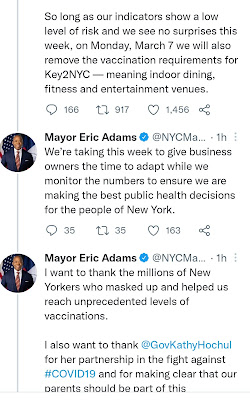
Come Monday, hundreds of thousands of public school students in the nation's largest district and their educators can ditch face masks indoors, Mayor Eric Adams said Friday as he announced the looming end of one of the most profoundly impactive and longstanding mandates of the COVID pandemic.
Businesses throughout the five boroughs won't have to check vaccine cards at the door either starting next week, though they can continue to do so if they choose.
Face masks will still be required for students younger than the vaccine-eligible age of 5, though, the Democrat announced, which affects some pre-K classes, all 3-K classes and many daycare and kids' programs overseen by the health department.
Parents of kids affected by the mandate's lifting can still send them to school with masks if they prefer, and schools will have face coverings handy for anyone in need. Adams acknowledged it may take time for some to feel comfortable without masks in certain settings and he says the city fully supports their right to discretion.
Further down:
Kids of kindergarten age or higher or staff who return to school after testing positive for COVID or experiencing symptoms also have to wear masks until 10 days have passed since the diagnosis or symptoms.
I asked my two kids what they want to do and they told me they both wouldn't mind continuing to wear their masks at school. We'll see how they feel on Monday.
The positivity rate is low now in NYC. That is good news. However, if anyone denies the impact of COVID-19, look at the CDC excess death figures cited in the Washington Post on February 15:
The United States has recorded more than 1 million “excess deaths” since the start of the pandemic, government mortality statistics show, a toll that exceeds the officially documented lethality of the coronavirus and captures the broad consequences of the health crisis that has entered its third year.
The excess-deaths figure surpassed the milestone last week, reaching 1,023,916, according to Robert Anderson, chief of the mortality statistics branch of the Centers for Disease Control and Prevention’s National Center for Health Statistics. The center updates its estimate weekly.
Although the vast majority of the excess deaths are due to the virus, the CDC mortality records also expose swollen numbers of deaths from heart disease, hypertension, dementia and other ailments across two years of pandemic misery.
“We’ve never seen anything like it,” Anderson said.
In 2019, before the pandemic, the CDC recorded 2.8 million deaths. But in 2020 and 2021, as the virus spread through the population, the country recorded roughly a half-million deaths each year in excess of the norm.
The virus emerged in China in late 2019 and began killing people there in January 2020. It did not spread significantly in the United States until that February, and it wasn’t until the final week of March 2020 that it began to send the excess-deaths metric soaring.
Later on:
Steven H. Woolf, director emeritus of the Center on Society and Health at Virginia Commonwealth University, said Tuesday that his published studies on excess deaths during the pandemic have consistently shown that 80 to 85 percent were caused by the virus directly. The remainder can largely be attributed to disruptions caused by the pandemic, he said.
“The economic and psychological stresses of the pandemic take their toll,” Woolf said.
The pandemic exacerbated existing health disparities and led to much higher mortality among Black and Hispanic people, particularly early in the crisis, research has shown. A Washington Post analysis last year found that at the time, in the 40-to-64 age bracket, 1 in 480 Black people, 1 in 390 Hispanic people and 1 in 240 Native Americans had died during the pandemic, compared with 1 in 1,300 White people and Asian people.
The United States on the whole has an unusually high rate of chronic health conditions, such as obesity, diabetes and heart disease, and has a long-recognized “health disadvantage” compared with other wealthy nations.
That disadvantage was exacerbated by a weak and scattershot response to the pandemic, Woolf said. Other countries that reacted more quickly or took more aggressive postures to control viral spread early on were able to limit their death toll as well as long-term economic impacts, he said.
“We did not handle it well. That’s glaringly obvious,” he said. “The other countries got hit by the same virus, but no country has experienced the number of deaths we have, and even if you adjust for population, we are among the highest in the world.”
If some are reluctant to say let's just move on and try to forget about the last two years, it's understandable.